

Business Operation · 2025
In this section23 topics
- Corporate Information4 items
- Dividend Policy2 items
- Major Shareholders2 items
- Business Strategies Overview5 items
- Material Changes & Developments1 item
- Use of Proceeds from Securities Offerings1 item
- Commitments Made in the Registration Statement1 item
- Group Operating-Structure Policy1 item
- Companies Where the Company Holds ≥10%1 item
- Shareholders with Potential Conflict of Interest1 item
- Relationships Among Major Shareholders2 items
- Shareholders' Agreement1 item
- Shareholding Diagram (Group Structure)3 items
- Income Structure3 items
- Product / Service Characteristics2 items
- Research & Development6 items
- Assets Used in the Business6 items
- Marketing Policy & Competition2 items
- Procurement of Products & Services7 items
- Product Information — Overview1 item
- Projects Under Construction1 item
- Debentures & Bills of Exchange1 item
- Convertible Securities1 item
Corporate Information
Company Name
PRIMA MARINE PUBLIC COMPANY LIMITED
Telephone
0-2016-0190-4
Website
www.primamarine.co.th
comsec_pr@primamarine.co.th
Dividend Policy
Dividend Policy
The Company establishes a dividend payment policy for shareholders, stipulating a minimum distribution of 30% of net profit from separate financial statements, after deducting taxes and all legally required reserves as specified by applicable laws and the Articles of Association. This dividend payment ratio may be adjusted if necessary or deemed appropriate by the Board of Directors. Annual dividend payments require approval by the Meeting of Shareholders, except in the case of interim dividends. The Board of Directors may approve interim dividend payments when considered beneficial, and such payments must be reported to the Meeting of Shareholders for acknowledgment at the next meeting.
Historical Dividend Payments
| This Year | Last Year | 2 Years Ago | 3 Years Ago | 4 Years Ago | Metric | Description | Remark |
|---|---|---|---|---|---|---|---|
| 0.87 | 0.81 | 0.5 | 0.44 | 0.47 | Net profit per share (Baht : Share) | Net profit per share (baht : share) | |
| 0.5 | 0.48 | 0.35 | 0.34 | 0.26 | Dividend per share (Baht : Share) | Dividend per share (baht : share) | |
| 0 | 0 | 0 | 0 | 0 | Dividend stock ratio (Number of original shares: dividend shares) | Ratio of stock dividend payment (existing share : stock dividend) | |
| 0.5 | 0.48 | 0.35 | 0.34 | 0.26 | Dividend share value per share (Baht : Share) | Value of stock dividend per share (baht : share) | The Board of Directors’ Meeting No. 2/2026 held on 26 February 2026 has passed the resolution to propose the 2026 Annual General Shareholders Meeting for approval the dividend payment for the year 2025 to the Company’s shareholders at the rate of 0.50 Baht per share. The Company paid an interim dividend to all shareholders at the rate of 0.25 Baht per share on October 24, 2025. Therefore, the remaining dividend to be paid to the shareholders at the rate of 0.25 Baht per share. The date of the dividend payment will be on May 26, 2026.
|
| 1,250,000,000 | 1,200,000,000 | 875,000,000 | 675,000,000 | 650,000,000 | Total dividend payment value (Baht : Share) | Total dividend payment (baht : share) | On September 3, 2025, the Company is scheduled to complete its share repurchase program, undertaken for financial management purposes. A total of 280,000,000 shares will be repurchased, accounting for 11.20% of the Company's total issued shares. The repurchased shares will be ineligible for dividend payments. |
| 63.27 | 62.97 | 65.06 | 76.65 | 55.84 | Dividend payout ratio to net profit (%) | Dividend payout ratio compared to net profit (%) |
Business Strategies Overview
Chairman's Message
Prima Marine Public Company Limited is projected to sustain stable growth in 2025 despite a highly uncertain environment characterized by volatile economic conditions, geopolitical conflicts, border tensions, appreciation of the Thai baht, and natural disasters. This stability is attributed to the implementation of proactive policies, agile business plan adjustments, timely decision-making, and disciplined management.
Increased investment in acquiring vessels for the Offshore Support Vessel ("OSV") business, aimed at meeting customer demand for offshore exploration and production drilling both domestically and internationally, as well as the acquisition of large crude oil tankers to provide long-term services to expanding domestic refineries, has led to significant revenue growth in both business segments. Notably, the OSV business has experienced rapid expansion, substantially mitigating the impact of external fluctuations on the Company's other business segments in 2025.
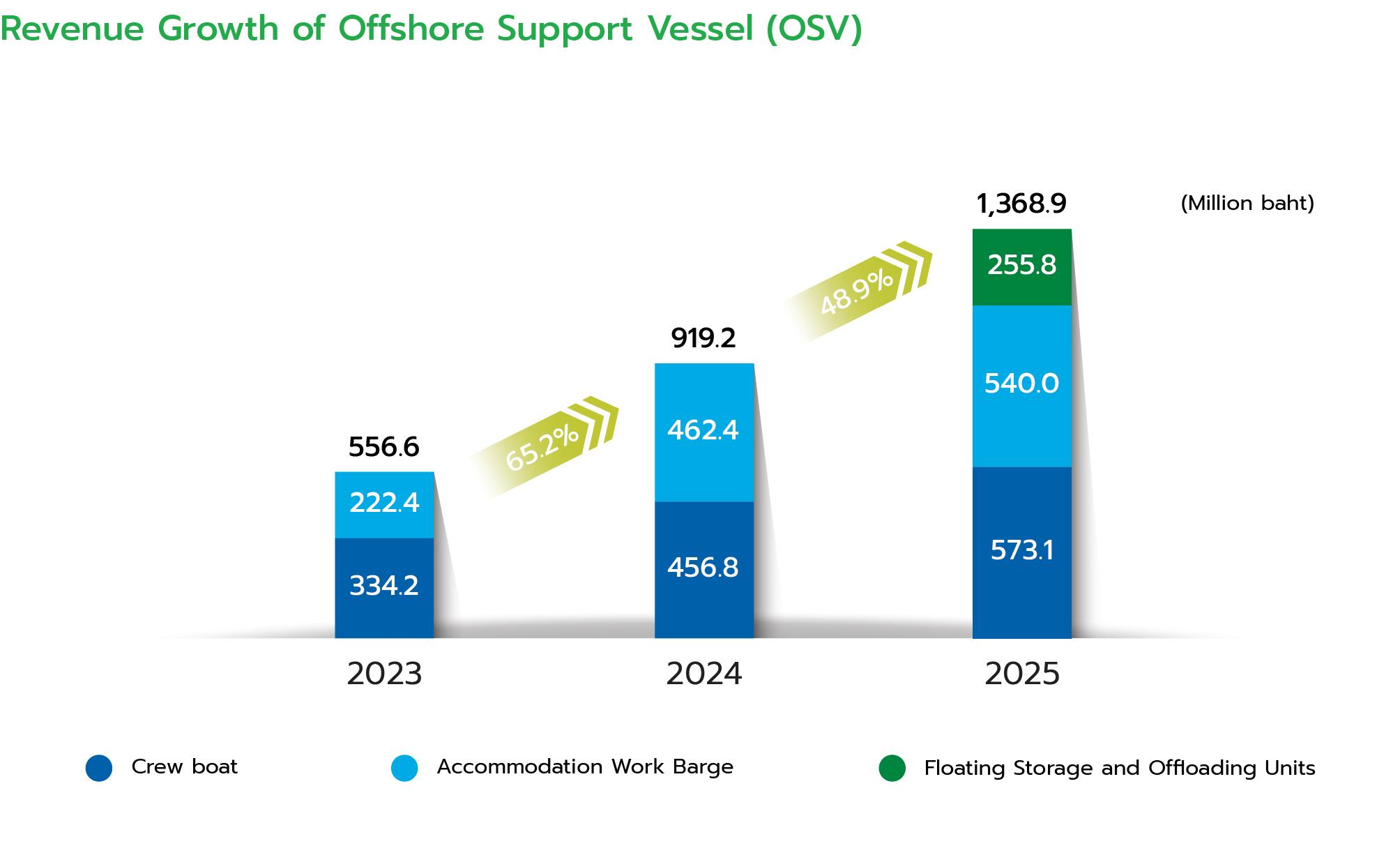
The Petroleum and Chemical Tanker ("PCT") business, a stable and core revenue source, was affected by unrest along the Thai - Cambodian border, resulting in the suspension of refined oil transportation services to Cambodia in late 2025. In response, the Company revised its operational plans and shipping routes to address the evolving situation and reallocated vessels to serve international petrochemical transportation clients. As part of its long-term strategy, the Company is gradually investing in the construction of new vessels with higher deadweight tonnage ("DWT"). These vessels are designed to maximize efficiency, accommodate specific shipping routes and geographical conditions, and achieve significant energy cost savings. They will replace older vessels that have reached the end of their service life and support market expansion both domestically and in neighboring countries. The first three new vessels are scheduled for completion in 2026.
The Floating Storage Unit (FSU) business, which represents an additional driver of the Company's growth, a 2025 business policy has been established that prioritizes collaboration with reliable customers not exposed to risks associated with US sanctions. The policy mandates comprehensive risk assessments based on Know Your Customer (KYC) principles and requires close cooperation with insurance companies and international sanctions enforcement agencies to verify the origin and accuracy of cargoes prior to transportation or storage on Company vessels. These measures are intended to mitigate potential risks to sustainable growth and safeguard stakeholders' long-term interests. In line with this business principle, the Company is prepared to invest in additional FSU vessels to address anticipated customer demand in this segment.
The Company demonstrates financial discipline through efficient working capital management across all operations. This strategy involves rigorous evaluation and oversight of investment project risks to secure planned returns, alongside fostering accountability for cash flow. These measures have resulted in a strong financial position and have maintained the confidence of both domestic and international financial institutions. Robust cash flow and effective management enabled the repurchase of 280 million ordinary shares by the end of 2025 and supported consistent dividend payments. As a result, the Company was included in the SET High Dividend 30 (SETHD), which recognizes securities with high and stable dividend yields on the Stock Exchange of Thailand.
Alongside its business success, the Company continues to prioritize sustainable development within the framework of Environment, Social and Governance ("ESG"). It has set clear goals to achieve carbon neutrality by 2030 and net-zero greenhouse gas emissions by 2050, while ensuring efficient operations and resource utilization with environmental considerations in all aspects. This includes designing high-efficiency new vessels and utilizing hybrid propulsion systems to reduce energy consumption and continuously decrease carbon dioxide emissions. Due to its commitment to good governance and rigorous environmental initiatives, the Company has received an AA ESG Rating, has been certified by the Thai Private Sector Anti-Corruption Coalition (CAC) for the second consecutive year, and is projected to achieve a 5-star corporate governance rating in 2025.
The Company will continue to accelerate its expansion into international markets and increase investment in businesses with high customer demand both domestically and internationally. Concurrently, the Company plans to enhance its management structure and human resource capabilities to effectively manage the anticipated growth in international operations. Revenue is projected to increase from 2026 onwards, driven by six offshore exploration and production support vessels commencing service under long-term contracts in 2025 and contributing full-year revenue in 2026. In addition, three new, highly efficient oil and petrochemical tankers will enter service in 2026, replacing older vessels and those previously leased.
On behalf of the board of directors, I thank our shareholders, customers, business partners, financial institutions, and all stakeholders for their continued support. I also thank our management team and employees for their dedication and professionalism, which have driven our success in 2025 and established a strong foundation for ongoing, stable, and sustainable growth.

Mr. Bowon Vongsinudom
Chairman
Vision
The Company will be a leading organization in the maritime transport business and provide comprehensive support for offshore petroleum exploration and production in the Asia-Pacific region, excelling in operations and providing reliable offshore transportation and storage services. The Company uphold fairness toward all stakeholders and prioritize customer satisfaction, while promoting sustainable growth in accordance with principles of good governance, environmental stewardship, and social responsibility.
Objectives
The group of Companies is dedicated to delivering comprehensive maritime services to the petroleum industry in Thailand and is actively expanding its international operations. This strategy seeks to achieve sustainable growth and profitability, both tangible and intangible, for all stakeholders. Additionally, the Company aims to enhance national energy security, which serves as a critical foundation for economic development and the long-term improvement of societal and environmental quality of life.
Goals
The Company aims to achieve sustainable revenue and profitability growth by elevating operational standards to optimal efficiency. This strategy is designed to enhance customer satisfaction and trust in service quality, thereby supporting international recognition and facilitating expansion into global markets. Furthermore, the Group invests in businesses with long-term growth potential to ensure stable and sustainable revenue streams.
Simultaneously, the Company prioritizes building and maintaining strong relationships with business partners, suppliers, and customers across the supply chain. This commitment is complemented by integrating technology and innovation into operations to enhance efficiency, transparency, and auditability.
Additionally, the Company demonstrates environmental responsibility by targeting carbon neutrality by 2030 and net-zero emissions by 2050. These objectives are intended to ensure sustainable business stability, long-term growth, and organizational resilience.
Business Strategies
The group of Companies intend to deliver comprehensive services across all business segments to address customer requirements and ensure optimal satisfaction regarding service quality, operational standards, and safety. The principal elements of the strategy are outlined below:
1. Service Strategy Overview
The strategy emphasizes a one-stop service model encompassing the entire petroleum industry supply chain, from upstream to downstream operations. Services include the provision of support vessels for offshore exploration and production, crude oil tankers, refined oil and chemical tankers, offshore oil storage and blending vessels, as well as import and export documentation, onboard personnel, ship agency, and shipping line agency services.
Emphasis is placed on managing a high-quality, ready-to-service fleet, strictly controlling operations to ensure maximum safety for personnel, cargo, and customers, while delivering services on time as specified by customers.
Ship management is conducted by experts in strict compliance with all relevant national and international laws, standards, regulations, and requirements.
The Company seeks to expand its business and strengthen competitiveness in international markets by elevating operational standards to internationally recognized benchmarks and implementing proactive marketing initiatives. The strategy targets growth in crude oil, refined oil, and chemical transportation services, as well as offshore exploration and production support services, particularly in Asian countries where refinery capacity is increasing and petroleum-based energy remains a key economic driver.
Operating costs are managed efficiently through systematic planning for the procurement of materials, equipment, and maintenance. Supplier price and quality are evaluated by comparing bids from multiple sources to strengthen bargaining power and ensure long-term cost control.
Prioritize preventive maintenance to improve service efficiency, reduce unplanned downtime, and sustainably extend the lifespan of the fleet.
Technology is implemented to track, monitor, and report voyages, fuel consumption, and real-time issues, enabling prompt, efficient operational adjustments.
2. Marketing and Partner Relationship Strategy
The group of Companies prioritize marketing strategies and the development of strong business partner relationships, alongside continuous service quality improvement. These efforts are intended to drive growth, enhance competitiveness, and achieve strategic objectives, while ensuring sustainable operations and long-term financial stability. The Company's marketing and partnership strategy includes the following key approaches:
The Company emphasizes a thorough understanding of customer needs to develop efficient services that generate added value for both customers and the organization, while differentiating from competitors. For instance, vessels are designed with a low draft to address low-tide limitations, enabling continuous docking and cargo unloading without delays. This approach supports efficient customer transportation management and maximizes the Company’s asset utilization.
The Company establishes competitive service rates and implements efficient transportation planning and systematic cost management. These measures minimize cost transfer to service users and create sustainable long-term value.
The Company maintains and develops a network of high-potential brokers for vessel procurement, materials, equipment, and marketing support, both domestically and internationally. This approach enhances competitiveness and strengthens market expansion capabilities.
Focusing on building and maintaining strong relationships with customers on an ongoing basis. The Company focuses on cultivating long-term business partnerships with its clients through customer satisfaction surveys. Feedback is used to improve operations before, during, and after service delivery. Emphasis is placed on nurturing existing clients and expanding the customer base to include new, high-potential clients, ensuring consistently high levels of satisfaction as the foundation for long-term business partnerships. Furthermore, the group has established subsidiaries in key service areas to enhance convenience, speed, and close, continuous access to clients.
The Company consistently communicates information about its services and products to build awareness, understanding, and trust among partners and industry collaborators.
Business expansion occurs through strategic partnerships, joint ventures, and collaborative projects to strengthen business operations, develop new products and service models, and generate stable long-term returns.
Corporate communication is enhanced through the group's public communication channels to increase reach, build understanding of services, and foster trust among users, partners, and collaborators. The Company also participates in relevant industry trade shows and exhibitions to pursue business opportunities, expand collaborations, and proactively build strong partnerships.
3. Financial and Business Management Strategies.
The group of the company emphasizes prudent, disciplined financial management to strengthen financial stability, reduce exposure to external fluctuations, and promote sustainable, long-term growth. The following approaches are central to this strategy:
Implementing comprehensive exchange rate risk management to mitigate the effects of currency conversions, given that the Company's revenue is primarily denominated in foreign currencies rather than Thai Baht. Exchange rate volatility may significantly affect the Group's operations. Prioritizing the negotiation and acquisition of long-term service contracts to ensure revenue stability and improve financial forecasting, planning, and overall management efficiency. Overall organizational management efficiency.
Managing the revenue structure within each business group to achieve balance and alignment, thereby minimizing the impact of fluctuations in any single business and ensuring stable profitability.
Beyond these core services, marketing, and financial strategies, the Group recognizes the importance of its human resources as a fundamental driver of long-term growth.
Last year, the Company reorganized its workforce and reviewed its human resource development plans to align with the roles, responsibilities, and capabilities of each group. This ensures effective recruitment, development, and enhancement of personnel capabilities, aligning with each person's true potential and supporting sustainable, long-term organizational growth.
Material Changes & Developments
Material Changes & Developments
| Year | Description |
|---|---|
| 2,025 |
|
| 2,024 |
|
| 2,023 |
|
Use of Proceeds from Securities Offerings
Is There Money Raised from a Securities Offering Still to Report On?
No
Commitments Made in the Registration Statement
Are There Commitments or Conditions from an Offering or Listing?
No
Group Operating-Structure Policy
Description
The Company operates in marine transportation business, offshore petroleum exploration and production support vessel business, vessel management business, and shipping agency and customs clearance business. The Company divides its operations of the group companies to align with the business and strategies of the Group, to ensure efficient business operations.
Companies Where the Company Holds ≥10%
Companies (≥10% Holding)
| Company Name | Address | Province | Zip Code | Telephone | Business Type | Security Type | Shares | Paid-up Shares |
|---|---|---|---|---|---|---|---|---|
| Protea Investments Group Limited | Totala Pier Park, Building 1, Second Floor, Wickhams Cay I, Road Town, British Virgin Islands | Foreign country | - | International Marine Oil Transportation Investment and Services Company | Common shares | 10,000 | 10,000 | |
| Premier Tankers Limited | Totala Pier Park, Building 1, Wickhams Cay I, Second Floor, Road Town, Tortola, British Virgin Islands | Foreign country | - | Marine oil transportation services | Common shares | 10,000 | 10,000 | |
| Rediant Offshore Inc. | PH Albrook Park, Tower 3, Suite 301, Las Ixoras Street & Diogenes de la Rosa Avenue, Albrook, Ancon, Panama City, Republic of Panama | Foreign country | +507 399-8713 | Company invests in, provides transportation services for, and supports offshore petroleum exploration and production operations. | Common shares | 10,000 | 10,000 | |
| N.T.L. Marine Company Limited | 80 Soi Bangna-Trad 30, Thepratana Road, Bangna Tai Sub-district, Bangna District | Bangkok | 10260 | (+66) 2016 0190-4 | Marine oil transportation services | Common shares | 15,500,000 | 15,500,000 |
| Thai Marine Tanker Company Limited | 80 Soi Bangna-Trad 30, Thepratana Road, Bangna Tai Sub-district, Bangna District | Bangkok | 10260 | (+66) 2016 0190-4 | Marine oil transportation services | Common shares | 1,800,000 | 1,800,000 |
| Big Sea Company Limited | 454 Rama III Road, Bang Khlo Sub-district, Bang Kho Laem District | Bangkok | 10120 | (+66) 2292 2761 | Marine oil transportation services | Common shares | 359,998 | 360,000 |
| Phurich Marine Company Limited | 80 Soi Bangna-Trad 30, Thepratana Road, Bangna Tai Sub-district, Bangna District | Bangkok | 10260 | (+66) 2016 0190-4 | Marine oil transportation services | Common shares | 2,500,000 | 2,500,000 |
| Truth Maritime Co., Ltd. | 80 Soi Bangna-Trad 30, Thepratana Road, Bangna Tai Sub-district, Bangna District | Bangkok | (+66) 2016 0190-4 | Maritime Transportation Service for Oil and Petrochemicals | Common shares | 130,000,000 | 130,000,000 | |
| Truth Maritime Services Company Limited | 80 Soi Bangna-Trad 30, Thepratana Road, Bangna Tai Sub-district, Bangna District | Bangkok | 10260 | (+66) 2016 0190-4 | Offshore petroleum exploration and production support vessel business | Common shares | 13,000,000 | 13,000,000 |
| TNS Logistics and Agency Company Limited | 80 Soi Bangna-Trad 30, Theparattan Road, Bangna Tai Sub-district, Bangna District | Bangkok | 10260 | (+66) 2016 0190-4 | Shipping Agency and Customs Clearance Business | Common shares | 1,500,000 | 1,500,000 |
| Nathalin Management Company Limited | 80 Soi Bangna-Trad 30, Theparattan Road, Bangna Tai Sub-district, Bangna District | Bangkok | 10260 | (+66) 2016 0190-4 | Ship Management Business | Common shares | 85,000 | 85,000 |
| BSC Management Recruitment Company Limited | 80 Soi Bangna-Trad 30, Theparattan Road, Bangna Tai Sub-district, Bangna District | Bangkok | 10260 | (+66) 2746 9981-2 | Crew Recruitment Business | Common shares | 55,000 | 55,000 |
| T.I.M. Chip Management Company Limited | 80 Soi Bangna-Trad 30, Thepratana Road, Bangna Tai Sub-district, Bangna District | Bangkok | 10260 | (+66) 2745 7711-2 | Ship Management Agent | Common shares | 30,000 | 30,000 |
| Majestic Shipping Co., Ltd. | 80 Soi Bangna-Trad 30, Thepratana Road, Bangna Tai Sub-district, Bangna District | Bangkok | 10260 | (+66) 2016 0190-4 | Offshore oil storage and blending vessel business | Common shares | 12,000,000 | 12,000,000 |
| Nathalin Shipping Pte. Ltd. | 6 Temasek Boulevard, #32-03 Suntec Tower Four, Singapore (038986) | Foreign country | (+65) 6361 0382 | Offshore oil storage and blending vessel business | Common shares | 30,000,000 | 30,000,000 | |
| Amity Asset Management Inc. | PH Sortis Business Tower, 57 East Street, Obarrio, Panama City, Republic of Panama, P.O. Box 0843-02200 | Foreign country | (+507) 399-8713 | Offshore oil storage and blending vessel business | Common shares | 10,000 | 10,000 | |
| TMS OFFSHORE VENTURES INC | Agent Contact: Williamson Place, Building 0764-F, La Boca, Balboa, Panama City, Republic of Panama. | Foreign country | - | Offshore petroleum exploration and production support vessel business | Common shares | 1,000 | 1,000 | |
| V.C. Shipping and Service Co., Ltd. | 446/75 Soi Pridi Banomyong 20/1, Sukhumvit 71 Road, Khwaeng Phra Khanong Nuea, Khet Watthana | Bangkok | 10110 | (+66) 2392 7676-7 | Shipping Agency and Customs Clearance Business | Common shares | 5,000 | 5,000 |
| SRI SHAN PTE. LTD. | 6 TEMASEK BOULEVARD, #32-03, SUNTEC TOWER FOUR, SINGAPORE 038986 | Foreign country | - | Offshore oil storage and blending vessel business | Common shares | 50,000 | 50,000 | |
| TMN Company Limited | 3354/50 Manorom Building, 15th Floor, Rama IV Road, Khlong Tan Sub-district, Khlong Toei District | Bangkok | 10110 | (+66) 2671 7200 | Refined Petroleum and Chemical Tanker Business | Common shares | 66,600,000 | 66,600,000 |
Income Structure
Product / Service Income
| Category | Description | This Year | This Year % | Last Year | Last Year % | 2 Years Ago | 2 Years Ago % |
|---|---|---|---|---|---|---|---|
| Total revenue from operations | Total revenue from operations | 8,746,532.76 | 100 | 8,790,559.71 | 100 | 8,086,923.32 | 100 |
| Revenue from the Petroleum and Chemical Tankers Business | 3,462,507.69 | 39.59 | 3,591,876.46 | 40.86 | 3,339,329.64 | 41.29 | |
| Revenue from Crude Oil Carrier Business | 1,324,313.25 | 15.14 | 1,658,454.44 | 18.87 | 1,889,310.79 | 23.36 | |
| Revenue from the Floating Storage Unit Business | 2,404,243.33 | 27.49 | 2,496,597.3 | 28.4 | 2,205,046.22 | 27.27 | |
| Revenue from the Offshore Support Vessel Business | 1,368,882.74 | 15.65 | 919,186.98 | 10.46 | 556,553.85 | 6.88 | |
| Revenue from the Ship Agent and Shipping Business | 186,585.75 | 2.13 | 124,444.53 | 1.42 | 96,682.82 | 1.2 | |
| Other | Other | 0 | 0 | 0 | 0 | 0 | 0 |
Export Income
| Category | Description | This Year | This Year % | Last Year | Last Year % | 2 Years Ago | 2 Years Ago % |
|---|---|---|---|---|---|---|---|
| Total revenue | Total revenue from operations | 8,746,532.76 | 100 | 8,790,559.71 | 100 | 8,086,923.32 | 100 |
| Domestic | Domestic | 4,440,278.81 | 50.77 | 4,103,911.87 | 46.69 | 3,992,136.93 | 49.37 |
| International | International | 4,306,253.95 | 49.23 | 4,686,647.84 | 53.31 | 4,094,786.39 | 50.63 |
| Malaysia | Malaysia | 2,876,296.92 | 66.79 | 3,005,075.9 | 64.12 | 2,205,048.21 | 53.85 |
| United Arab Emirates | United Arab Emirates | 1,319,829.19 | 30.65 | 1,419,395 | 30.29 | 1,486,424.39 | 36.3 |
| Singapore | Singapore | 74,139.08 | 1.72 | 239,059.44 | 5.1 | 403,313.79 | 9.85 |
| Other countries | Others | 35,988.76 | 0.84 | 23,117.5 | 0.49 | 0 | 0 |
Other Income
| Operating Other Income | Non-Operating Other Income | Share of Profit |
|---|---|---|
| 1710 · As of year: 374869.12 · Description: Total other income · As of yesteryear: 167469.0 · As of year before yesteryear: 451844.0 · 1711 · As of year: 374869.12 · Description: Other income from operations · As of yesteryear: 167469.0 · As of year before yesteryear: 451844.0 | 1712 · As of year: 0.0 · Description: Other income not from operations · As of yesteryear: 0.0 · As of year before yesteryear: 0.0 | 1713 · As of year: 14237.93 · Description: Share of profit · As of yesteryear: 15864.0 · As of year before yesteryear: 26298.0 |
Product / Service Characteristics
Business Type
3114
Business Groups
| Business Group | Description |
|---|---|
| Petroleum and Chemical Tankers Business (PCT) | The Company provides vessel transportation services for the Petroleum and Chemical Tankers Business to customers operating oil refineries and major oil and chemical traders in Thailand and Southeast Asia. Services are provided using vessels with a deadweight tonnage (DWT) not exceeding 20,000 DWT, picking up goods from oil refineries, oil depots, or origin ports to destinations specified by customers. The Company must provide efficient transport vessels that meet customer requirements and crew members with expertise and competence to ensure safe transportation, as well as operate according to the agreed terms between the Company and the customer. The main shipping routes are divided into two types based on the category of Thai-registered vessels, as follows:
The Company's oil and chemical tankers will pick up goods from oil refineries, oil depots, or ports.
The Company's oil and chemical tankers will pick up goods from oil refineries, oil depots, or ports. Products transported by the Company Refined petroleum products such as diesel, gasoline, Jet A-1 aviation fuel, and chemical products such as paraxylene, benzene, cyclohexane, naphtha, toluene, etc. Types of Transportation Service Contracts The Company has three types of business agreements for transportation services, with details as follows:
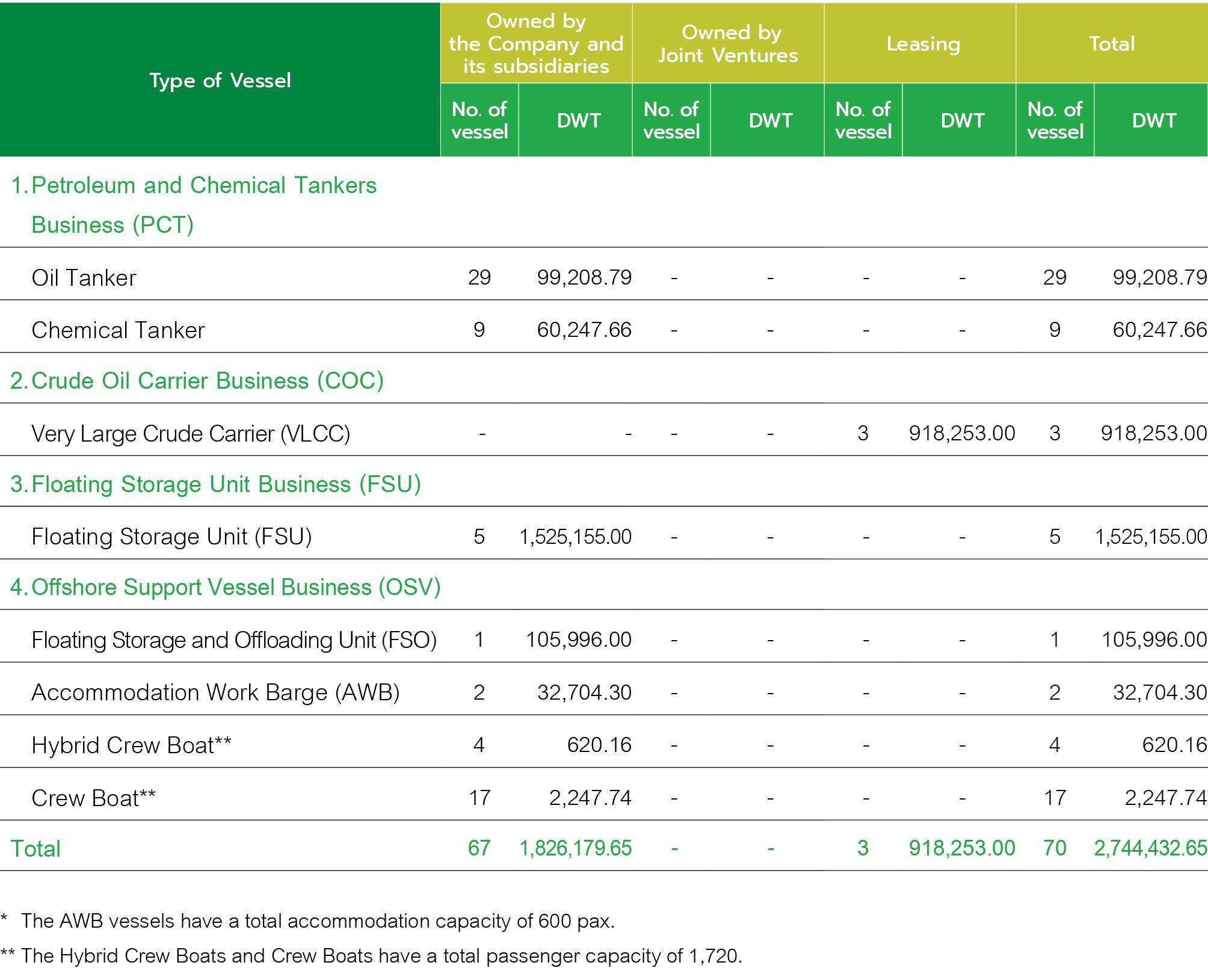
Vessels used in service As of December 31, 2025, the Company owns 38 vessels in the PCT business, comprising 29 refined petroleum product tankers and 9 chemical tankers, with an average fleet age of 17.3 years. |
| Crude Oil Carrier Business (COC) | The Company provides crude oil transportation services using Very Large Crude Carrier (VLCC) vessels with a carrying capacity of approximately 300,000 DWT, picking up cargo from origin ports in the Middle East and delivering it to destination ports in Thailand. Products transported by the Company : Crude oil Transportation Service Contract Model The service contract model for the Company's crude oil tankers is under a 10-year time charter agreement (with the first vessel commencing service in 2021, and the second and third vessels commencing service in 2022). The service rate is jointly determined between the client and the Company, based on a specific rate derived from the Company's vessel procurement costs, which does not fluctuate with the freight rates of VLCC vessels in the global market. Vessels used for service As of December 31, 2025, the Company has 3 vessels for service under the COC business through long-term charter agreements, with an average fleet age of 17 years. |
| Floating Storage Unit Business (FSU) | The Company provides Floating Storage Unit ("FSU") services by leasing storage tanks on vessels converted from Very Large Crude Carriers ("VLCC") with a deadweight tonnage (DWT) of approximately 300,000. Each vessel is equipped with approximately 15–17 large storage tanks to accommodate the storage and blending of oil according to specific customer requirements. The service model encompasses both full-charter and partial-charter tank rentals, along with three main service types: 1) cargo storage, 2) oil blending using Air Agitation and Internal Tank Transfer methods, and 3) oil heating services. Currently, the Company operates FSU vessels in Malaysian waters, specifically in the areas of Tanjung Pelapas, Johor Bahru, and Kukup, to support the storage and blending of crude oil, low sulphur fuel oil (not exceeding 0.5% by weight), and alternative biofuels, thereby efficiently meeting the energy market demands in the region. Products for which the Company provides transportation and storage services : Crude oil, fuel oil, and biofuel The majority of storage service contracts are time charter agreements, typically for a duration of 1 – 2 years. These contracts specify the berthing area, storage period, and storage fees, among other details. Vessels used for storage services The Company will procure FSU vessels suitable for customer requirements, taking into account the characteristics and properties of the stored goods, the quantity of goods, and the duration for which customers wish to store the goods. As of December 31, 2025, the Company possesses a total of 5 FSU vessels, with an average fleet age of 23.6 years. |
| Offshore Support Vessel Business (OSV) | The Company provides offshore petroleum exploration and production support vessels to petroleum exploration and drilling companies. It focuses on providing comprehensive support for operations on drilling rigs, including accommodation, personnel transportation, and crude oil storage from offshore oil rigs. Currently, the Company provides three main types of vessels: Accommodation Work Barges (“AWB”) for oil rig personnel, Crew Boats for passenger and cargo transport, and Floating Storage and Offloading Units (“FSO”) for crude oil transport and storage for oil rigs.
The Company provides accommodation vessels for oil rig personnel. These vessels are stationed near drilling rigs to facilitate accommodation, provisions, and medical services during offshore operations. Service contract types Services are provided under a Time Charter agreement with an approximate contract term of 5 years. Vessels used in service As of December 31, 2025, the Company has 2 AWB vessels operating in the central Gulf of Thailand oil fields. Each vessel can accommodate approximately 300 personnel and is equipped with essential facilities such as kitchens, dining rooms, and recreational areas to support continuous operations on oil rigs. The average age of the fleet is 13 years.
The Company provides Crew Boat services for transporting personnel and cargo between the shore and offshore drilling rigs to support offshore petroleum exploration and production activities in the Gulf of Thailand. In 2025, the Company aggressively marketed and expanded its services to the Middle East, marking a significant step in expanding its OSV business internationally. Service contract types Crew Boats provide services under two types of contracts: 1) Time Charter agreement, and 2) Bareboat Charter agreement. Under a Bareboat Charter, the Company provides the bare vessel and its equipment to clients who wish to operate and control the transport vessel themselves. The Company's responsibility is limited to delivering the vessel and its equipment. Meanwhile, the client is responsible for providing the crew, managing the vessel, and covering all associated expenses. The contract terms are approximately 2-5 years. Vessels used in service As of December 31, 2025, the Company has a fleet of 21 Crew Boats, comprising 17 conventional Crew Boats and 4 hybrid Crew Boats. Each vessel can accommodate 70–90 passengers, with a total maximum capacity of 1,720 passengers for the entire fleet. The average age of the fleet is 7.4 years.
The Company has experience in providing FSO vessel services, which serve as large offshore crude oil storage tanks. They are equipped with facilities to support direct oil transfer from production wells, including systems for separating seawater from crude oil before returning the treated seawater to the production source. FSO vessels play a crucial role in temporarily storing crude oil before it is offloaded to shuttle tankers for transport to refineries. As of December 31, 2025, the Company has 1 FSO vessel operating in the Gulf of Thailand under a 5+5 year Bareboat Charter agreement, which reflects a stable long-term revenue generation opportunity. |
| Ship Agent and Shipping Business (SAS) | The Company operates in the Shipping & Ship Agent Business. Its main operations are as follows:
The Company acts as an agent for cargo owners or clients to handle documentation for the export or import of goods. This involves liaising with the Customs Department for customs clearance, submitting import and export declarations to declare cargo items and for tax collection. It also assists in verifying the accuracy of documents, including cargo inspection and release. The Company helps manage the logistics system for goods from the country of origin to the consignee in the destination country, and provides other services related to import and export.
An agent for the Ship Owner or Master, responsible for notifying government agencies such as the Marine Department, Pilotage Division, Customs Department, Immigration Bureau, and International Communicable Disease Control Checkpoints, of the vessel's arrival or departure and its crew. This also includes arranging for tugboats, pilot boats/cars for pilot transfer, and line boats to assist vessels in safely berthing at/departing from various piers in accordance with port regulations. The companies within the group that operate in the Ship Agent and Shipping business include: 1) Truth Maritime Co., Ltd. (“TM”), 2) TNS Logistics and Agency Co., Ltd., and 3) V.C. Shipping and Service Co., Ltd. |
Research & Development
Has R&D Policy (Y/N)
Yes
R&D Cost — Description
Provision of Hybrid Crew Boat services for passenger and cargo transport.
The development of the innovative Hybrid Crew Boat project commenced in 2023, driven by the recognition of the significance of climate change and the aspiration to be a pioneer in the maritime transport industry, supporting its supply chain in achieving carbon neutrality targets. The Company partnered with a shipyard in Singapore to design the Hybrid Crew Boat with specific features for optimal energy efficiency, as detailed below:
-
The design of the hull structure and shape to minimize water resistance in accordance with hydrodynamic principles.
-
The application of a special hull coating with high efficiency in reducing marine fouling, thereby minimizing resistance during vessel movement.
-
Installation of an electric motor with the main engine to generate electricity during main engine operation.
-
The utilization of batteries to store energy generated by the electric motor, for alternating use in engine operation without reliance on fossil fuels.
The Company commenced operations of its first two Hybrid Crew Boats (TMS Ranot and TMS Raman) in Q1 2024, providing services in the Gulf of Thailand. These two vessels achieve fuel savings of 20-30% compared to the Company's conventional models and generate tangible returns through higher service rates, driven by innovation that promotes environmentally sustainable business operations. Furthermore, they have been certified by Lloyd's Register as the first two Hybrid Crew Boats in Southeast Asia to reduce energy consumption and greenhouse gas emissions, serving as a prototype for developing environmental innovations for other vessel types. The Company's innovation development expenses for the Hybrid Crew Boat project investment in 2024 totaled 468.78 million Baht.
In 2025, the Company expanded the scope of development and further enhanced its Hybrid Crew Boats by integrating the Gyro Stabilizer system into two additional Hybrid Crew Boats (ADNOC 05 and ADNOC 06) operating in the Middle East, an area characterized by stronger waves and winds than the Gulf of Thailand. This system utilizes gyroscopic force from a high-speed rotating heavy metal disc to counteract the vessel's rolling motion in high and severe wave conditions. This enhancement will mitigate seasickness, improve safety, and increase operational efficiency in offshore petroleum exploration and production activities, even amidst challenging sea conditions.
R&D Cost — Label
Research and development (R&D) expenses over the past 3 years (Million Baht)
R&D Cost — This Year
480.54
R&D Cost — Last Year
468.78
R&D Cost — 2 Years Ago
0.0
Assets Used in the Business
Permanent Assets — Description
As of December 31, 2025, the Group had fixed assets used in business operations, after deducting accumulated depreciation as presented in the Group's consolidated statement of financial position, totaling 12,762.60 million Baht.
Permanent Assets — Appraisal
| Asset | Ownership | Obligation | Appraisal Value | Description |
|---|---|---|---|---|
| Land | Owner | Mortgage registration as collateral with a financial institution | 33.1 | Details are as specified in “Attachment 4: Assets Used in Business Operations and Details Regarding Asset Valuation Items.” |
| Buildings and Building Improvements | Owner | Mortgage registration as collateral with a financial institution | 27.8 | Details are as specified in “Attachment 4: Assets Used in Business Operations and Details Regarding Asset Valuation Items.” |
| Seagoing vessels and major repair costs | Owner | Mortgage registered as collateral with a financial institution for 44 units. | 11,279.3 | Details are as specified in “Attachment 4: Assets Used in Business Operations and Details Regarding Asset Valuation Items.” |
| Assets Under Construction and Installation | Owner | No obligations | 536.2 | Details are as specified in “Attachment 4: Assets Used in Business Operations and Details Regarding Asset Valuation Items.” |
| Equipment used on board vessels | Owner | No obligations | 873.2 | Details are as specified in “Attachment 4: Assets Used in Business Operations and Details Regarding Asset Valuation Items.” |
| Furniture and Office Equipment | Owner | No obligations | 5.4 | Details are as specified in “Attachment 4: Assets Used in Business Operations and Details Regarding Asset Valuation Items.” |
| Vehicle | Owner | No obligations | 7.6 | Details are as specified in “Attachment 4: Assets Used in Business Operations and Details Regarding Asset Valuation Items.” |
Intangible Assets — Description
As of December 31, 2025, the Group possessed intangible assets utilized in business operations, net of accumulated depreciation, as presented in the Group's consolidated statement of financial position, totaling 118.50 million Baht.
Intangible Assets — Appraisal
| Asset | Type | Type (if Other) | Appraisal Value | Description |
|---|---|---|---|---|
| Computer program | Software | 20.4 | Rights to use computer programs for the general business operations of the Group of Companies, such as accounting system programs, executive reporting programs, inventory management accounting programs, and general operational programs. | |
| Customer List | Others | - | 25.4 | The Company acquired customer lists through its investment, resulting in the said entity becoming a subsidiary of the Company. |
| Long-term service agreement | Others | - | 72.7 | The Company secured a long-term service contract through the investment, which resulted in the entity becoming a subsidiary of the Company. |
Has Subsidiaries Investment Policy (Y/N)
Yes
Subsidiaries Investment Policy — Description
The Company has a policy to invest in related, similar, or beneficial businesses that support the Company's operations, in order to enhance its stability and performance. The Company has established the following investment policy to serve as a guideline for its operations.
-
The business to be invested in must be one with the potential to generate consistent revenue and profit, and must have undergone project risk assessment and feasibility analysis.
-
The business to be invested in must have sufficient cash flow to service its debt obligations and interest.
-
The business to be invested in must provide an appropriate return for an acceptable level of risk, with an Equity Internal Rate of Return (EIRR) of not less than 12%, or as deemed appropriate based on prevailing market conditions.
-
The Company shall not invest in businesses that are illegal or immoral.
-
Such investments must be approved by the Chief Executive Officer, or the Executive Committee, or the Board of Directors, or the Shareholders' Meeting, in accordance with laws, regulations, or the Company's articles of association, as the case may be.
-
The Company will primarily invest in businesses related to maritime transportation and supporting offshore petroleum exploration or production activities. Should there be investments of other types, they must be approved by the Chief Executive Officer, the Executive Committee, the Board of Directors, or the Shareholders' Meeting, in accordance with laws, regulations, or the Company's articles of association, as the case may be.
-
For investments in subsidiaries and associates, the consideration of the investment amount will depend on the business relationship. If it is a business with a strong relationship to the Company's operations, the Company may invest more than 50%, and it will be considered a subsidiary of the Company. For investments in other entities, the Company may invest from 20% up to 49.99%, which will be considered an associate of the Company. However, the Company may review investments in subsidiaries and associates to ensure they are consistent and appropriate with the Company's business conditions.
Furthermore, in supervising the operations of subsidiaries and associates, the Company will appoint its representatives to serve as directors in such subsidiaries and associates. These representatives may include the Chairman, Chief Executive Officer, directors, senior executives, or any individuals with appropriate qualifications and experience in the businesses in which the Company invests. They must be free from conflicts of interest with the businesses of those subsidiaries and associates. The Company's representatives must manage and operate the businesses of the subsidiaries and associates in accordance with the rules and regulations stipulated in the Company's articles of association and relevant laws pertaining to the operations of such subsidiaries and/or associates.
Marketing Policy & Competition
Reporting Mode
3116
Per-Business-Group Breakdown
| Marketing Policy | Industry & Competition |
|---|---|
Target Customers The Company's target customers are large oil companies, oil refineries, and major oil and chemical traders both domestically and internationally, such as PTT Public Company Limited, Shell (Thailand) Company Limited, Chevron (Thailand) Company Limited, Esso (Thailand) Public Company Limited, Thai Oil Public Company Limited, Bangchak Corporation Public Company Limited, and PETCO Trading Labuan Company Limited (Petronas Group), among others. Pricing Policy The Company determines transportation service fees based on the type of service contract. Key factors considered in calculating transportation service fees include the nature of transportation, transportation routes, transportation duration, and type of goods, among others, with details as follows:
The Company has a policy for determining transportation service rates. as follows:
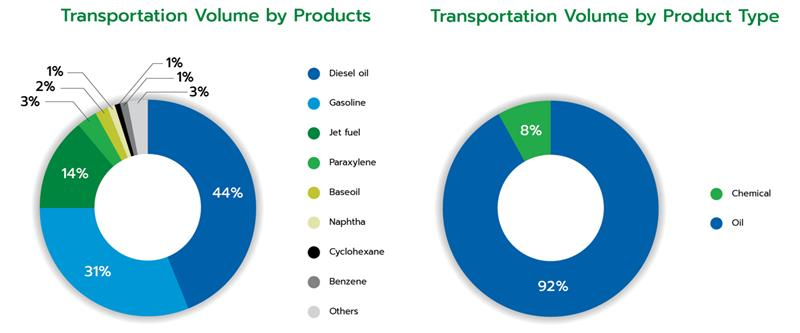
| The refined petroleum and chemical tanker industry is characterized by a market with a small number of operators, as it is a business that requires very high capital investment, both in terms of investing in vessels and specialized equipment, as well as high operating expenses such as fuel costs, personnel costs, and insurance premiums. Furthermore, it must strictly adhere to safety standards and regulatory requirements, resulting in a relatively high barrier to entry. Competition in the industry therefore focuses on reliability, operational safety, long-term customer relationships, and cost management efficiency. In 2025, the company had a total refined petroleum and chemical transport volume of 10,275 million liters, comprising 9,489 million liters of refined petroleum and 786 million liters of liquid chemicals, which reflects the company's competitive capability and stable customer base.
|
Target Customers The target customers for the crude oil carrier business are large oil refinery customers who require importing crude oil from abroad to refine it into finished products domestically. In this business, the company provides services using VLCC-sized vessels, which are used for importing crude oil from the Middle East, such as the United Arab Emirates. Pricing Policy Service fees can be determined by referencing market freight rates at the time of the service contract. However, currently, the company provides crude oil tanker services to only one customer, Thai Oil Public Company Limited. This service is provided under a 10-year long-term contract, with service fees agreed upon between the company and the customer based on the company's vessel procurement costs. This arrangement ensures that the company is not exposed to the risks of fluctuating market freight rates. | The international crude oil tanker industry has numerous operators compared to the domestic shipping business and experiences high volatility influenced by global economic conditions, oil demand, and global freight rates. Despite the large number of players, market entry still requires substantial capital investment, especially for large vessels such as VLCCs, and necessitates experience in analyzing market trends and managing risks related to freight rates and fuel costs. Currently, the Company operates three VLCC vessels, which is considered a small fleet compared to major players in the Asian region. However, the Company focuses on a cautious investment strategy, considering projects with potential and forming commercial partnerships to generate stable long-term income (Recurring Income) and reduce volatility from the Spot market. |
Target Customer Group and Pricing Policy In this business, the company's primary target group consists of refineries and international oil trading companies. The company has a policy for setting appropriate storage service fees (Storage Fee) for customers, based on the nature and conditions of storage services. Key factors considered for calculating service fees include product type, storage volume, vessel size, and storage duration. The company's pricing policy is as follows:
| The FSU business is characterized by high capital investment and requires expertise in blending and storing oil to meet customer-specified quality without loss. Furthermore, the location for vessel anchorage is a critical competitive factor, as operators must obtain an Anchorage License from the government and renew the license annually. The primary clientele consists of foreign oil companies with operational bases in Singapore and Malaysia, which are regional oil trading hubs, and distribute products to the Asia-Pacific region. Competition in this business is therefore evaluated based on reliability, precision in product blending, availability of anchorage locations, and long-term relationships with major clients, rather than solely on price competition. |
Target Customer Group The Company's target customer group in the OSV business is offshore oil and gas exploration and production companies, which currently includes both domestic customers and customers in the Middle East. Pricing Policy In determining service rates, the Company will consider the service model and terms of service. Key factors considered in calculating service fees include the type of cargo, vessel size, vessel type, shipping route, and service duration. The Company will set prices by comparing service rates with competitors and market prices, taking into account the operating costs of each vessel type. The Company will charge service fees categorized by service type as follows:
The Company will consider pricing based on customer demand and market competition concurrently. | The OSV industry in the Gulf of Thailand has a limited number of operators due to the high capital investment required for acquiring specialized vessels and equipment, as well as high insurance costs. It also demands specialized expertise and strict adherence to safety standards, all of which pose significant barriers to entry for new operators. Regarding AWB vessels in the Gulf of Thailand, there are a total of 4 vessels in service, with 2 of these belonging to the Company, representing 50% of the market share. This reflects the Company's strong competitive position in this market. For Crew Boats in Thailand, there are only 3 main service providers. The Company's fleet is considered the youngest in terms of average age compared to other operators in the market, which is a significant supporting factor for transportation safety and service efficiency, constituting one of the Company's competitive advantages. Furthermore, the Company commenced services for two hybrid Crew Boats, to customers in the Gulf of Thailand starting in 2024. These vessels are certified as the first set of Hybrid Crew Boats to operate in Southeast Asia. The Company is the sole provider in Thailand capable of offering this type of vessel under an Exclusivity Agreement with the shipyard, resulting in the Company holding a 100% market share for Hybrid Crew Boats in Thailand. These Hybrid Crew Boats incorporate technology that enhances fuel efficiency for navigation and helps reduce greenhouse gas emissions. This not only elevates the Company's technological competitiveness but also reflects its commitment to sustainable business practices and alignment with international environmental trends. |
Target customer groups and pricing policy The Company's target customer groups include companies engaged in freight forwarding, import, and export businesses, particularly in the petroleum and chemical industries, as well as industrial goods. The Company's pricing policy is as follows:
The Company sets service rates based on principles of transparency, fairness, and market alignment, taking into account cost structures, complexity of work, and associated risks at each port and for each vessel type. The key approaches are as follows:
The Company determines customs clearance service rates by considering the actual cost structure, the complexity of the route and mode of transport (sea, land, or multimodal transport), service duration, cargo volume, and the level of service required by the customer. The key approaches are as follows:
| The Ship Agent and Shipping business are characterized by relatively high competition due to a large number of service providers and easier market entry compared to businesses requiring high-value assets. However, competitiveness depends on business networks, technology, operational systems, expertise, and service quality. The company has developed this business from being a related operation to its core transportation services, enabling the provision of integrated services covering transportation, ship agency, and customs clearance. This facilitates smooth operations for customers. The acquisition of V.C. Shipping and Service Co., Ltd., which has extensive experience in the Shipping business, helps strengthen the service network, technology, and potential customer base. This enables the company to compete in terms of quality, speed, and reliability. |
Procurement of Products & Services
Reporting Mode
3117
Procurement (Overall)
The company's services must procure essential raw materials and resources, namely: (1) transportation service contracts, (2) vessels, (3) fuel for marine operations, (4) crew manning, and (5) vessel maintenance.
Raw Material Acquisition (Overall)
-
Securing Transportation Service Contracts
The Company has two channels for securing transportation contracts: 1) bidding for projects and 2) direct engagement.
-
Bidding for Projects
The Company will participate in bidding processes directly. Prior to bidding, the Company will analyze the project's Terms of Reference (TOR) and evaluate its potential returns. If the Company determines there is a strong chance of winning the bid and generating appropriate returns, it will approve participation in the bidding and prepare a project proposal for the client or organization.
-
Direct Engagement
The Company will accept direct engagements from clients by preparing service contracts or work orders. However, the Company will determine whether to use a contract or work order format based on the type of transportation or storage service, whether it is SPOT, COA, or TC.
-
Vessel Procurement
The Company will procure vessels suitable for client requirements, which can be categorized into transportation services and storage services. For transportation services, clients will provide essential details such as cargo type and volume, origin and destination ports, and desired transportation dates and times. For storage services, clients will provide essential details such as cargo type and volume, desired waters or mooring areas, and service duration. The Company employs three methods for vessel procurement: 1) purchasing second-hand vessels, 2) new shipbuilding, and 3) chartering vessels from external parties (for transport vessels only).
-
Purchasing Second-hand Vessels
The Company will contact brokers, both domestic and international, to source vessels and inspect their condition. A large number of vessels will be screened from agents to ensure good quality, reasonable prices, and technical specifications that meet client requirements. The Company will also assess the costs of vessel refurbishment and maintenance to conduct a Feasibility Study, provided that the project is deemed to offer a worthwhile return on investment.
The Company will seek approval from the Board of Directors for vessel purchases. The acquisition of second-hand vessels will be based on the type, specifications, and age of the vessel, ensuring suitability for client requirements. The process for completing a second-hand vessel purchase typically takes 3 to 6 months. After the purchase, additional vessel improvements may be undertaken before the vessel is put into service for clients, including repairs, installation of additional equipment, fuel procurement, and engaging a vessel manager. The vessel manager will handle crew management, obtain various licenses such as vessel registration and operating permits, and arrange Hull and Machinery Insurance (H&M Insurance) and Protection and Indemnity Insurance (P&I Insurance).
There are numerous shipbrokers in the industry, making it unnecessary to enter into a vessel procurement contract with a specific agent, as prices, vessel specifications, and payment terms can be compared to secure the best and most cost-effective conditions.
-
New Shipbuilding
The Company will consider new shipbuilding in cases where a vessel meeting the client's requirements cannot be found, or if new shipbuilding offers greater value than purchasing a second-hand vessel, for instance, due to lower maintenance costs, better fuel efficiency, more effective operating systems, and a longer service life.
After understanding client requirements, the Company will contact shipyards to request proposals for technical and price comparison, to assess project feasibility (Feasibility Study), and to seek approval from the Board of Directors. Subsequently, the shipyard will prepare detailed vessel construction designs to proceed with shipbuilding. The Company will oversee the quality of the vessel throughout the construction period. New shipbuilding for vessels with a deadweight tonnage (DWT) of less than 10,000 DWT will take approximately 12 to 18 months, while vessels exceeding 10,000 DWT will take approximately 24 to 36 months. As the transport vessel nears completion, the Company will engage a vessel management team to prepare the vessel for service. This involves key steps such as installing additional equipment, procuring fuel, recruiting crew members, obtaining various licenses (e.g., vessel registration, operating permits), and arranging Hull and Machinery Insurance (H&M Insurance) and Protection and Indemnity Insurance (P&I Insurance).
The Company compares prices, specifications, shipbuilding quality, and payment terms in various countries such as China, Japan, and Korea, among others, to obtain the most favorable and cost-effective investment conditions.
-
Chartering Vessels from External Parties
The Company will consider chartering vessels from third parties if it cannot provide its own vessels on the date and time required by the client. The Company will contact vessel owners directly or through agents to charter vessels, meticulously verifying the vessel's details and specifications, as well as all relevant licenses, to ensure that the chartered vessel meets the client's specified standards and requirements and is suitable for the client's cargo before each engagement.
-
Marine Fuel (Bunker)
The Company procures marine fuel from leading domestic and international oil suppliers on its Approved List. The Company has verified the quality and operational standards of these oil traders to ensure that the purchased fuel is of high quality for vessel engines. The Company will contact at least two oil suppliers to inquire about prices, specifying the quantity, type of fuel, and delivery location, to compare price reasonableness for approval by authorized personnel. Subsequently, the sales department will contact the oil suppliers to provide delivery details. However, following the International Maritime Organization's IMO2020 regulation, which came into effect globally on January 1, 2020, requiring all vessels to switch from High Sulphur Fuel Oil to Low Sulphur Fuel Oil or install exhaust gas cleaning systems (scrubbers) to reduce air pollution and mitigate greenhouse gas effects contributing to global warming, the Company decided to adopt Low Sulphur Fuel Oil instead of installing scrubbers due to lower investment costs. In 2020, the Company transitioned all vessels in all business segments operating on international shipping routes from High Sulphur Fuel Oil to Low Sulphur Fuel Oil. The Company procures Low Sulphur Fuel Oil through overseas suppliers and refuels at destination cargo ports.
-
Crew Recruitment
Crew recruitment strictly adheres to maritime regulations set by various authorities, such as the International Maritime Organization (IMO) and governmental agencies overseeing maritime affairs and ports. The Company recruits and selects personnel and crew members through various channels, including job announcements via maritime training centers and navigation schools, such as the Asian Maritime Technology College and Maritime School, or through maritime journals, company employees, its website, and social media platforms like Facebook and Line. Key selection criteria include:
-
Having completed training courses approved by the Marine Department or other relevant agencies to comply with applicable international maritime regulations.
-
Holding licenses or certificates issued by relevant authorities.
-
Should have at least 2 years of work experience relevant to the applied position.
-
English language proficiency (for Captain and Officer positions).
-
Having passed knowledge tests and interviews with supervisors.
Furthermore, the Company mandates training organized by both internal personnel and external instructors. This training aims to ensure crew members understand onboard procedures and operational methods. The main training categories are divided into four types as follows:
-
Safety Training involves courses designed to enable crew members to handle emergencies, such as Basic Fire Fighting, Personal Survival, Personal Safety, and Elementary First Aid courses.
-
Navigation Training involves courses designed to enable crew members to navigate vessels accurately and safely to their destinations, such as Radar Simulation, Bridge Team Management, and Ship Simulator courses.
-
Engine Room Training involves courses designed to familiarize crew members with the mechanics and operation of onboard systems and the engine room, such as Engine Room Management, Engine Room Operation, and High Voltage courses.
-
Specific Training is necessary because each type of cargo transported or stored requires different care or management. Therefore, additional training is required, such as Oil Tanker Training, Gas Tanker Training, and Chemical Tanker Training courses.
-
Vessel Maintenance
The Company's vessel maintenance planning is divided into two types: 1) Preventive Maintenance and 2) Dry Docking, with details as follows.
-
Preventive Maintenance
Preventive maintenance involves maintaining the hull, machinery, onboard equipment, electrical systems, various control systems, and piping installed on the vessel. This maintenance is performed according to scheduled intervals, mileage, or manufacturer's recommendations. The Company has its own in-house maintenance team and also engages contractors from its Approved Vendor List. For vessels not exceeding 5 years of age, preventive maintenance can be conducted through an underwater survey instead of dry-docking during the first 30 months, which typically takes 5 to 7 days to complete.
-
Dry Docking
Dry-docking or major vessel repairs occur every 5 years, depending on the vessel's age, aligning with project timelines agreed upon with clients to ensure smooth operations. This involves inspecting the vessel's steel structure and various onboard systems, such as the propulsion engine system, internal electrical and lighting systems, communication systems, navigation control systems, piping and cargo handling equipment, cargo tanks, and onboard safety systems. Each dry-docking operation, from lifting the vessel out of the water to returning it, takes approximately 3 to 8 weeks, depending on the vessel's age and deadweight tonnage. For each dry-docking, the Company plans in advance to avoid impact on
The Company's transportation and cargo storage services utilize approximately 4 to 5 regular shipyards. These shipyards maintain high service standards, offer reasonable service rates, and can accommodate multiple vessels for dry-docking simultaneously, thereby ensuring no impact on operations.
Distributors (Overall)
The criteria for classifying critical raw material suppliers are based on the Company's direct trade relationships with them, their significant role in business operations, and possessing at least one of the following two characteristics:
-
Top Spending Suppliers are those with a high total value of purchase orders or service contracts, accounting for 80% of the total procurement value within a specified period, which reflects their importance in terms of both budget and operational continuity.
-
Non-Substitution Suppliers are those with specialized products, services, or technology, possess copyrights, are limited manufacturers/service providers, or are the sole producers in the market, making it impossible to switch to substitute products or services from other vendors.
Number of Raw-Material Distributors (Overall)
14
Production Capacity (Overall)
| Item | Unit | Unit (if Other) | Used | Capacity |
|---|---|---|---|---|
| - | Others | None | 0 | 0 |
Domestic/Overseas Purchase Proportion (Overall)
| Raw Material | Source Country | Value |
|---|---|---|
| Seagoing vessel | Singapore | 1,252,537,398.65 |
| Marine Fuel | Thailand | 611,005,670.23 |
| Marine Fuel | Singapore | 424,791,953.02 |
| Marine Fuel | Malaysia | 5,646,658.14 |
Product Information — Overview
Introduction
Projects Under Construction
Has Projects Under Construction (Y/N)
No
Debentures & Bills of Exchange
Has Debentures (Y/N)
No
Convertible Securities
Has Convertible Securities (Y/N)
No