CG Policy · 2025
In this section7 topics
Corporate Governance Policy
Has a Corporate Governance Policy
Yes
Policy Description
The Board of Directors recognizes and understands the importance of Good Corporate Governance and believes that good corporate governance principles are crucial factors in achieving maximum success in business operations. These principles will help promote the Company and its subsidiaries as efficient organizations, both in business operations and in their responsibility towards all stakeholder groups, with transparent, efficient, and socially responsible operational governance systems, building confidence among shareholders, investors, and all related parties. This is achieved by adhering to and complying with good corporate governance principles, such as the Good Corporate Governance Principles for Listed Companies of the Securities and Exchange Commission (SEC) and the Stock Exchange of Thailand, as well as the criteria under the Corporate Governance Report (CGR) project of the Thai Institute of Directors (IOD), and environmental, social, and governance performance assessments such as ESG Rating. The Company believes that good corporate governance principles constitute a management system that fosters fairness, builds investment confidence, and creates long-term value for shareholders and all stakeholders. It ensures appropriate, efficient, and highly effective management, promoting the organization's competitiveness for sustainable growth.
The Company recognizes that having a good corporate governance policy and a code of business conduct is a crucial foundation for strengthening the organization's corporate governance standards. Therefore, the Company has established a corporate governance policy and a code of business conduct for directors, executives, and employees to serve as guidelines for their operations. The Company believes that adhering to good corporate governance principles will promote appropriate and efficient organizational management, generate returns and increase long-term value for shareholders and investors, and build confidence among all stakeholders, which will lead to enhancing the Company's competitiveness and sustainable growth.
Communication of Good Corporate Governance Policy
The Company has announced and implemented its good corporate governance policy for the awareness and compliance of directors, executives, and employees of the Company and its subsidiaries. Additionally, a Good Corporate Governance and Business Ethics Handbook has been prepared for directors, executives, and employees to study and understand the Company's good corporate governance policy and to ensure correct compliance. Furthermore, orientation sessions are provided for current and new employees to ensure they understand good corporate governance. The Company's good corporate governance practices are reviewed annually, and employees are informed of any revisions to the good corporate governance policy each time they occur.
Policy & Practices — Board of Directors
Has Policy & Guidelines for the Board
Yes
Board Guidelines
| Guideline | Other — Please Specify | Detail |
|---|---|---|
| Nomination of Directors | The recruitment and appointment of directors and executives have taken into consideration the organization's size, composition, skills, experience, education, abilities, and specific qualifications that are appropriate and necessary to guide the company towards its stated goals and objectives. Directors
Executives Possess suitable qualifications in terms of knowledge, abilities, experience, and specialized expertise consistent with the Company's business strategies, laws, and/or relevant regulations, to be proposed to the Board of Directors for consideration and appointment to the positions of Chief Executive Officer, Deputy Chief Executive Officer, or Director of Finance and Accounting (as the case may be), while the Executive Committee will be responsible for screening, selecting, and appointing individuals to other departmental director positions. The Nomination and Remuneration Committee is responsible for defining the qualifications and criteria for the recruitment of executives for the positions of Chief Executive Officer, Deputy Chief Executive Officer, and Director of Finance and Accounting, and proposing their appointment to the Board of Directors for consideration (as the case may be), as well as assigning the Executive Committee to define the qualifications and criteria for the recruitment of executives for other departmental director positions in accordance with relevant rules and/or laws, and to appoint individuals to such other departmental director positions. | |
| Determination of Director Remuneration | The Company's directors are entitled to receive remuneration from the Company in the form of rewards, meeting allowances, gratuities, bonuses, or other benefits, including per diems and various welfare benefits, in accordance with the Company's regulations. This remuneration shall be consistent with the duties and responsibilities of each director. The director's remuneration must be at an appropriate level, comparable to companies listed on the Stock Exchange of Thailand and within the same industry group, and also reflect the Company's performance. The Nomination and Remuneration Committee shall consider and approve such remuneration and propose it to the Board of Directors for submission to the Annual General Meeting of Shareholders for approval of the director's remuneration payment. | |
| Independence of the Board of Directors from the Management | The Company has established a policy to separate the roles and responsibilities between the Board of Directors and the management. The Board of Directors is primarily responsible for setting policies, vision, mission, direction, strategies, and key operational plans for the Company. This includes overseeing the management's execution of the established plans, as well as deliberating, expressing opinions, and casting votes on important matters. This ensures that the Board of Directors, under the leadership of the Chairman, maintains independence in decision-making, enabling them to effectively and efficiently set policies and oversee the management's operations. Company has also clearly separated the roles and responsibilities between the Chairman of the Board and the Chief Executive Officer, ensuring they are not the same person. This is to ensure a balance of power and transparency, separating oversight and management functions. The Chairman of the Board is responsible for leading the Board of Directors and presiding over shareholder meetings and Board of Directors meetings. The Chief Executive Officer is responsible for conducting business and managing daily operations (Day to Day operation) in accordance with the scope of authority, policies, business plans and budgets, vision, and mission as resolved by the Board of Directors. In addition, the to establish the scope, roles, duties, and responsibilities of the Board of Directors and management clearly, to enhance operational agility and strengthen the mechanism of checks and balances, which enables the Board of Directors to independently oversee the performance of the management. | |
| Director Development |
| |
| Board Performance Evaluation | The Company stipulates that the Board of Directors and sub-committees must conduct performance evaluations at least once a year, both in the form of individual self-assessment and committee assessment, for the Board of Directors to consider the results and improvement guidelines to enhance operational efficiency, with clear evaluation guidelines and topics. The criteria and evaluation procedures are as follows:
| |
| Corporate Governance of Subsidiaries and Associated Companies | The Company has established a policy for the control and supervision of its subsidiaries and associated companies to define important guidelines for overseeing their operations, enabling the Company to manage its business and supervise its subsidiaries and associated companies in accordance with the Company's various policies, as well as to comply with public company laws, securities and exchange laws, and all relevant notifications, regulations, and criteria issued by the Capital Market Supervisory Board, the Securities and Exchange Commission, and the Stock Exchange of Thailand. | |
| Other guidelines regarding the board of directors | Board Meeting |
|
| Other guidelines regarding the board of directors | Meeting of non-executive directors | The Company held meetings between independent directors and non-executive directors to discuss important management issues such as overall operating performance, performance evaluation of senior executive positions, and the establishment of remuneration criteria for senior executives. Following these meetings, the independent directors and non-executive directors reported the meeting results to the executive directors and management for consideration of recommendations in future operations. In 2025, meetings between independent directors and non-executive directors were held on March 25, 2025, and April 24, 2025. |
Code of Conduct
Has a Business Code of Conduct
Yes
Code of Conduct Description
The company acknowledges the significance of ethics and a code of conduct in its business operations. To ensure that the board of directors, management, and employees at all levels comply with these principles when performing their duties and engaging with stakeholders with honesty, integrity, fairness, and equality, the company has established a "Code of Conduct" as a guideline and standard for management and operations. This framework operates alongside the company's regulations and is consistent with its vision and business objectives.
In addition, the company has implemented a sustainability policy and related practices to ensure that employees at all levels operate in accordance with the company's objectives, goals, and strategies for responsible business conduct toward society and the environment. This approach includes establishing sustainable development guidelines and targets, with an emphasis on key sustainability issues such as corporate governance, human rights, and labor practices, safety, occupational health, and environmental protection, as well as the management of carbon dioxide emissions from business activities.
In 2025, the Company received no complaints or breaches of business ethics from its stakeholders, including its directors and executives, and no offenses or legal violations resulted in legal penalties. The Company has disclosed these practices on its website under the headings "Corporate Governance" and "Company Policies and Documents."
Code of Conduct Practices
| Guideline | Detail | Document Link |
|---|---|---|
| Prevention of Misuse of Inside Information | The Company has established a policy on preventing conflicts of interest and guidelines for considering transactions that have or may have conflicts of interest, for the Board of Directors, executives, and employees to adhere to. This involves complying with the criteria for entering into connected transactions and avoiding actions that create conflicts of interest. The Company's Board of Directors will ensure compliance with the prescribed procedures prudently, based on principles of reason and independence, and with a transparent process for approving transactions. Furthermore, the Company has guidelines to prevent conflicts of interest, requiring directors and executives to disclose any interests that may conflict with the Company. When a transaction that may involve a conflict of interest arises, it must be reported to the Company immediately to prevent such conflicts, in accordance with the Securities and Exchange Act, regulations, announcements, and orders of the Capital Market Supervisory Board and the Stock Exchange of Thailand, including compliance with requirements regarding the disclosure of connected transactions. | https://www.primamarine.co.th/storage/download/cg/policy/20240205-prm-conflict-of-interest-policy-th.pdf |
| Anti-corruption | The Company regards anti-corruption as a fundamental principle in its business operations, by adopting a Zero Tolerance Policy against corruption and strictly adhering to all applicable anti-corruption laws in Thailand. This includes establishing a written anti-corruption policy, which sets forth criteria and guidelines to prevent the Company and its employees from violating anti-corruption laws. It also aims to foster knowledge, understanding, and practical approaches for directors, executives, and employees at all levels to comply with the anti-corruption policy. Furthermore, the Company encourages vigilance and reporting of observed corruption through designated channels. The anti-corruption policy and guidelines are communicated to the Board of Directors, executives, employees, as well as subsidiaries, joint ventures, other companies under the Company's control, business partners, and stakeholders, to ensure their awareness and strict adherence to the anti-corruption policy. In addition, the Company is a member of Thailand’s Private Sector Collective Action Coalition Against Corruption ("CAC Project"). The Company also provides whistleblowing channels and protection for informants when personnel wish to report information or seek advice regarding compliance with anti-corruption measures. | |
| Whistleblowing and Protection of Whistleblowers | The Company places importance on good corporate governance, adhering to conducting business with integrity, ethics, and strict compliance with relevant laws and regulations. It also expects directors, executives, and employees at all levels to consistently uphold and adhere to these principles. To promote transparency and stakeholder participation, the Company has established a policy for receiving complaints and whistleblowing regarding misconduct and corruption. It provides various channels for complaints, covering executives, employees, and stakeholders, as well as defining systematic guidelines for receiving reports, fact-finding, and taking action within appropriate and clear timeframes. Upon receiving a complaint, the Company will conduct a fact-finding investigation through the relevant departments. If the complaint is found to have merit, an investigation committee will be appointed to consider and proceed according to established procedures, including imposing disciplinary actions and/or legal proceedings as appropriate for the case. In addition, the Company prioritizes the protection of complainants and informants by implementing measures to prevent all forms of harassment or retaliation, as well as strictly maintaining the confidentiality of information. This is to build trust among whistleblowers and support the creation of a sustainable transparent and verifiable organizational culture. Channels for Complaints and Whistleblowing Whistleblowing Hotline on the Company's website, send an email to the Head of the Compliance Unit at compliance@primamarine.co.th Letter to the Chairman of the Audit Committee (who is an independent director) or a Director of the Company at the following address: Prima Marine Public Company Limited, 80 Soi Bangna-Trad 30, Theparak Road, Bangna Tai Sub-district, Bangna District, Bangkok 10260. Email to AuditCommittee@primamarine.co.th | |
| Preventing the Misuse of Inside Information | The Company has established guidelines for the preservation and prevention of the use of its internal information, including a policy on the use of inside information and securities trading. This policy prohibits directors, executives, and employees of the Company who possess inside information from disclosing secrets or inside information to unrelated entities, other individuals, or disclosing such information that has not yet been made public. In the event that any person discloses such information or uses it for their own benefit or the benefit of others, or engages in transactions that may create a conflict of interest, it shall be considered a serious offense and will result in disciplinary action. The Company has communicated these guidelines and policies to everyone in the organization for strict adherence. Furthermore, the Company requires all directors and executives who are legally obligated to report securities holdings to regularly submit such reports to the Company Secretary and disclose them in the Company's annual report. This also includes issuing warning letters to directors, executives, and employees who are aware of financial statements or any other information that may affect securities prices, instructing them to refrain from trading securities for at least one month before the Company's financial statements are released to the public (Blackout Period). Furthermore, executives and employees at all levels are obligated to adhere to the principles of data confidentiality and prevent others from accessing the Company's information, customer data, partner data, or personal information of others. This includes implementing and maintaining measures for the care and protection of confidential information or information that is not yet public. | |
| Prevention of money laundering | The Company prioritizes the prevention of and non-involvement in money laundering by maintaining accounts and assets accurately, transparently, and in compliance with the law, to ensure that business operations are free from involvement in illegal activities. The Company does not accept, convert, or support the acceptance or conversion of assets related to illegal acts, to prevent the Company's business from being used as a channel to conceal or disguise the origin of illicit assets, which could cause damage to the Company and its stakeholders. Furthermore, the Company has a process for selecting and conducting transactions with reliable customers and partners who operate their businesses lawfully, and exercises caution in transactions that may involve risks. | |
| Giving or receiving gifts, entertainment, or business entertainment | Directors, executives, and employees should avoid accepting any gifts or benefits, whether in the form of goods, services, or any other monetary or non-monetary advantages, from business partners or individuals involved with the Company's business, for personal gain, whether direct or indirect, unless the Company has specifically stipulated criteria. However, directors, executives, and employees may accept business hospitality when it is for the benefit of the Company, which requires appropriate discretion, and should avoid accepting hospitality that is excessive or inconsistent with normal business relationships. | |
| Compliance with laws, rules and regulations | The Company places importance on compliance with laws, regulations, and requirements related to business operations. It stipulates that directors, executives, and employees must study, understand, and strictly adhere to them, and must not take any action or omit to act in a manner that would violate or contravene laws, regulations, or rules, whether directly or indirectly. This also includes cooperating in inspections or legal proceedings under their respective duties and responsibilities. | |
| Use and maintenance of data and assets | Directors, executives, and employees are responsible for the proper use and care of company assets, as well as for safeguarding the company's confidential information. Specifically, personal data must comply with applicable laws and established policies. All duties must be performed with honesty and integrity, prioritizing the company's best interests, and without using or disclosing information or assets for personal gain or for the undue benefit of others. Furthermore, the company respects intellectual property rights and strictly adheres to relevant laws. It also promotes knowledge and raises awareness among personnel at all levels, and ensures that business documents and financial reports are prepared accurately, transparently, and in accordance with relevant standards. | |
| Anti-competitive | The Company adheres to a policy of refraining from any actions that may lead to unfair trade practices, interfere with or obstruct market mechanisms, free competition, or hinder the business operations of others. The Company will treat its trade competitors equally within the framework of good and fair competition or the regulations of supervisory bodies. Furthermore, the Company will not seek confidential information through dishonest means or damage the reputation of its trade competitors. | |
| Cyber security | The Company prioritizes information security, which is a crucial component in supporting the Group's business operations to be efficient and reliable. This is considered the responsibility and duty of executives, employees, and external parties authorized to use the Company's information systems, who must act to ensure the Company's information security. Furthermore, the Company establishes guidelines for maintaining the security of information systems and/or cybersecurity, including controlling data access, controlling data encryption, and establishing environmental security, to ensure that information systems are accurate, reliable, maintain data confidentiality, are always available, and are regularly audited. In addition, the Company mandates training and supports employees in acquiring appropriate knowledge and skills, and fostering awareness regarding relevant information security. Moreover, the Company conducts annual assessments of the knowledge and understanding of employees and relevant parties in information technology system security, to continuously strengthen a cybersecurity culture throughout the organization. | |
| Environmental management | The Company conducts its business with a strong emphasis on responsibility towards the community, society, and the environment. It prioritizes the safety and quality of life of the public, alongside effectively maintaining environmental sustainability and conserving natural resources. Furthermore, the Company supports the efficient and sustainable use of resources, and encourages and promotes employees' awareness of social and environmental responsibility. In addition, the Company emphasizes providing environmental knowledge and training to employees, including strict adherence to relevant laws and regulations, while continuously participating in activities that contribute to community and social development, and environmental conservation. | |
| Human rights | The company upholds human rights and is committed to their protection by ensuring fair treatment of all stakeholders, grounded in human dignity, equality, and equal freedom. The company prohibits violations of fundamental rights and discrimination based on race, nationality, religion, language, skin color, gender, age, education, physical condition, or social status. Additionally, the company will ensure that its business operations are not associated with human rights violations, including child labor and sexual harassment. In addition, the company has established guidelines for handling human rights violations to monitor and investigate reports of potential violations, ensuring that those affected receive appropriate compensation and redress or that the impact is mitigated. This includes fact-finding investigations, issuing apologies, providing monetary and non-monetary compensation, imposing penalties, and taking preventative measures to avoid recurrence. | |
| Occupational health and safety | The Company prioritizes safety, occupational health, and the creation of a conducive working environment, and is committed to fostering a culture of safety and occupational health in the workplace. To this end, a Safety, Occupational Health, and Working Environment Committee (Kor Pho Aor.) has been established to oversee safety operations and define guidelines for preventing accidents and occupational diseases in accordance with laws and internationally recognized safety and occupational health standards. Furthermore, the management and employees of the Group are responsible for strictly adhering to safety and occupational health requirements and regulations, regularly undergoing training, and being informed of communications regarding safety and occupational health issues. They are also expected to identify, report, and participate in preventing or mitigating risks that may endanger safety and hygiene in the workplace, thereby minimizing risks and preventing accidents that may arise from normal operational procedures to the fullest extent possible. Additionally, the Company encourages its stakeholders to be conscious and aware of safety, which will contribute to a safe working environment and enhance the quality of life for employees and the Company's stakeholders. |
Promoting Compliance with the Code of Conduct
Promotes Compliance by Directors, Executives and Employees
Yes
Description
The Company prioritizes continuous personnel development in terms of knowledge, skills, ethics, and morality, as well as instilling a sense of honesty, integrity, and responsibility in its personnel. In 2025, the Company communicated good corporate governance and business ethics to 100% of its directors, executives, and employees to promote awareness and understanding of work ethics and their respective roles. This also includes organizing new employee orientation via e-learning and conducting annual ethics knowledge tests to assess comprehension and underscore the importance of ethical work practices and the Company's good corporate governance operations.
Anti-Corruption Networks & Projects
Introduction
The Company has successfully renewed its certification as a member of the Private Sector Collective Action Coalition Against Corruption (CAC) for the second time on December 26, 2068. This certificate will be valid for 3 years from the date of approval. This membership certification reflects the Company's commitment to systematically and strictly implementing the principles and practices of its Anti-Bribery and Corruption Policy. Furthermore, it involves communicating the No Gift Policy internally to ensure all executives and employees are aware of it, and sending letters to business partners requesting their cooperation in refraining from offering gifts to the Company's executives and employees.
Joined or Declared Intent to Join Anti-Corruption Networks
Yes
Networks & Projects Joined
| Network / Project | CAC Certified |
|---|---|
| Thai Private Sector Collective Action Against Corruption: CAC | Y |
| United Nations Global Compact (UNGC) | |
| Participation of anti-Corruption networks and initiatives |
Material Changes & Developments in CG
Reviewed the CG Policy or Board Charter in the Past Year
Yes
Material Changes or Developments in the Past Year
Yes
Policy Review — Description
Over the past year, the Company has reviewed and updated its corporate governance practices as follows:
1. The Company has amended and supplemented its policies
-
Risk Management Policy, to cover both current risks and new risks that may arise in the future, along with incorporating Environmental, Social, and Governance (ESG) principles, COSO ERM, and COSO ESG to elevate risk management standards across the organization.
-
Information and Information System Security Policy, by adding principles, guidelines, and the use of Artificial Intelligence (AI) to establish a framework for AI usage that is appropriate and consistent with the Company's business operations.
-
Securities Trading Policy for Directors, Executives, and Employees, by revising the definition of related persons to align with current sub-committees and organizational structure, including procedures for reporting securities holdings and changes in holdings.
-
Anti-Corruption Policy, by expanding the definition of "fraud" to cover various forms, including adding a definition for conflicts of interest, and enhancing content related to risk assessment and internal controls to more clearly address fraud and corruption issues.
-
Human Rights Policy, by expanding the scope of the policy to more clearly cover stakeholders such as shareholders, investors, business partners, customers, communities, including vulnerable and at-risk groups. It also adds detailed guidelines on labor and human rights practices, and practices related to personal data protection (PDPA), as well as establishing a system for remedial measures, whistleblowing, whistleblower protection, and a more comprehensive policy review.
-
Risk Policy, by expanding consideration to cover economic, social, and environmental dimensions.
2. Reviewed the charters of all sub-committees and found that these charters remain consistent with current good corporate governance practices and principles; therefore, no amendments were made.
Implements the CG Code for Listed Companies
No
CG Code — Description
The Company regularly reviews and implements measures to enhance and improve its policies and practices in accordance with good corporate governance principles annually, to meet the standards of the Corporate Governance Code (CG Code) for listed companies in 2017, and applies them to corporate governance suitable for the Company's business context, to maximize long-term benefits and build credibility for all shareholders and stakeholders. However, in 2025, the Complies with CG The Code still has Points that are not in compliance with There is a practice in accordance with the CG Code regarding the tenure of two independent directors who will complete more than 9 consecutive years of service at the Annual General Meeting of Shareholders in 2026. The Board of Directors has considered and is of the opinion that the aforementioned independent directors possess the qualifications of independent directors, are capable of providing independent opinions, and comply with relevant criteria. Furthermore, they are specialized experts who can continuously provide support and beneficial recommendations for the company's business operations.
Other CG Performance & Outcomes
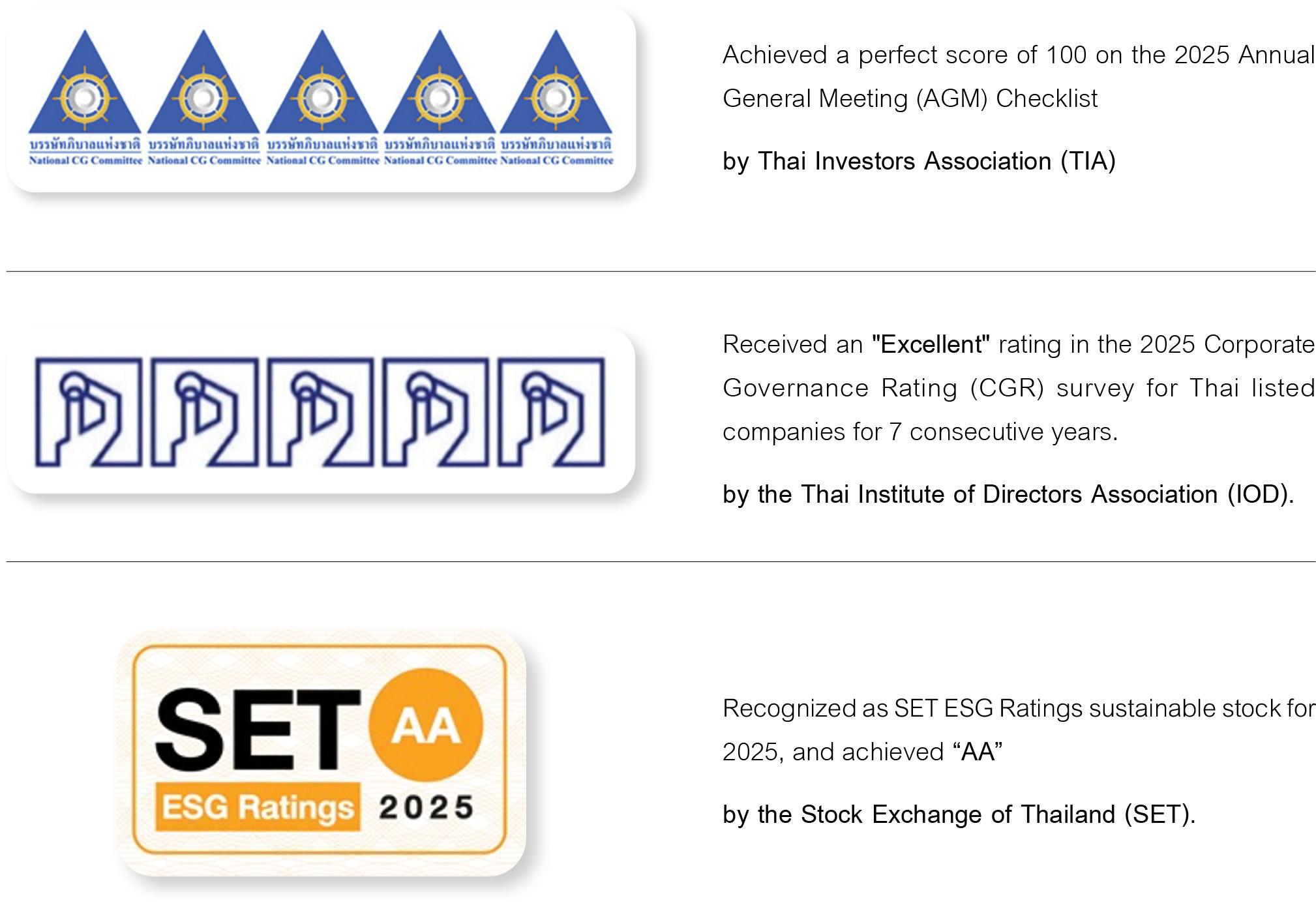
The Company received an "Excellent" rating, a 5-star score, from the Corporate Governance Report of Thai Listed Companies (CGR) project by the Thai Institute of Directors Association.
The Company held its 2025 Annual General Meeting of Shareholders via electronic media (E-AGM) and received a perfect score of 100 points in the Shareholder Meeting Quality Assessment (AGM Checklist) from the Shareholder Meeting Quality Assessment Project by the Thai Investors Association.
The Company received an "AA" rating in the 2025 SET ESG Ratings.
The Company received its second consecutive CAC certification renewal (2025 - 2028) from the Collective Action Coalition Against Corruption (CAC) project.