

Sustainability · 2025
In this section53 topics
- Sustainability Policy2 items
- Sustainability Goals & UN SDGs3 items
- Policy Review3 items
- Business Value Chain1 item
- Stakeholder Analysis2 items
- Environmental Sustainability — Overview1 item
- Environmental Policy & Guidelines3 items
- Environmental Policy Review1 item
- Energy — Plan & Guidelines2 items
- Energy — Electricity Consumption1 item
- Energy — Fuel Consumption1 item
- Energy — Targets2 items
- Energy — Performance & Outcomes2 items
- Water — Plan & Guidelines2 items
- Water — Withdrawal, Discharge & Consumption1 item
- Water — Targets2 items
- Water — Performance & Outcomes2 items
- Waste — Plan & Guidelines2 items
- Waste — Generation, Disposal & Recycling1 item
- Waste — Targets2 items
- Waste — Performance & Outcomes2 items
- GHG — Plan & Guidelines2 items
- GHG — Emissions1 item
- GHG — Emissions Verification2 items
- GHG — Principles & Standards1 item
- GHG — Targets1 item
- GHG Targets — Net Zero1 item
- GHG Targets — Carbon Neutrality1 item
- GHG — Performance & Outcomes2 items
- Environmental Legal Incidents2 items
- Other Environmental Management1 item
- Social Policy & Guidelines3 items
- Social Policy Review2 items
- Social — Principles & Standards Practised1 item
- Human Rights Due Diligence2 items
- Employees — Plan & Guidelines3 items
- Employees — Workforce2 items
- Employees — Remuneration & Provident Fund2 items
- Employees — Training & Development2 items
- Employees — Occupational Health & Safety1 item
- Employees — Labour Relations3 items
- Employees — Employee Representation2 items
- Employees — Targets2 items
- Employees — Performance & Outcomes2 items
- Customers — Plan & Guidelines3 items
- Customers — Satisfaction Results1 item
- Customers — Targets2 items
- Customers — Performance & Outcomes2 items
- Community & Social — Plan & Guidelines3 items
- Community & Social — Targets2 items
- Community & Social — Performance & Outcomes2 items
- Other Social Management1 item
- Law Violation Incidents1 item
Sustainability Policy
Has a Sustainability Policy
Yes
Policy Description
The Company is committed to being a "leader in petroleum and petrochemical transportation" by adhering to the principles of Sustainability Development as a crucial driving force for its business and as a key to defining management and operational guidelines across economic, social, and environmental aspects. The framework for Sustainability Development (Corporate Governance and Sustainability Development) is regularly reviewed to align with strategies and operational goals, aiming to create long-term sustainable value for the business.
The three key components enabling the Company to achieve sustainable development are economic growth, social inclusivity, and environmental protection. To support this, the Company has adopted the United Nations Sustainable Development Goals (SDGs) as a guideline to drive sustainable development in alignment with its business strategy and vision. This involves ensuring continuous business growth, fostering employee collaboration, raising awareness of sustainable development objectives as an integral part of the corporate strategy, conducting business based on good corporate governance principles, transparency, and anti-corruption, while consistently promoting and developing valuable human resources for both the Company and society, to meet the expectations of both internal and external stakeholders.
Sustainability Goals & UN SDGs
Has Sustainability Goals
Yes
Goals Description
The company has set sustainability management goals across three dimensions: the environmental dimension, such as achieving carbon neutrality for Scope 1 and 2 by 2030 and net-zero greenhouse gas emissions by 2050; the social dimension, such as zero accidents, no complaints regarding human rights violations, and educational support; and the economic and corporate governance dimension, such as customer satisfaction with the company's operations and corporate governance being rated excellent by internationally recognized or equivalent agencies.
Key Sustainable Development Goals and Performance
Environmental dimension
|
Annual performance for 2025 |
Target |
|
|
Climate management |
CFO certified |
Carbon Neutrality Scope 1 and 2 by 2030 and Net Zero by 2050 |
|
Nets obtained from the old net for cooking oil project |
152 kilograms |
100 kilograms |
|
Treated ballast water |
100% |
100% |
|
Complaints regarding environmental impact |
0 cases |
0 cases |
|
Environmental fines |
0 Baht |
0 Baht |
Social Dimension

|
Annual performance for 2025 |
Target |
|
|
Average training hours |
56.92 hours/person/year |
12 hours/person/year |
|
Organizational commitment |
89.7% |
Greater than or equal to 80% |
|
Number of Lost Time Injury (LTI) incidents |
0 incidents |
0 incidents |
|
Complaints regarding human rights violations |
0 cases |
0 cases |
Corporate Governance and Economic Dimension

|
Annual performance for 2025 |
Target |
|
|
Number of partners assessed annually |
100% |
100% |
|
CAC membership renewal |
Renewed |
Renewed |
|
CGR score |
Excellent level |
Excellent level |
|
Complaints regarding corruption |
0 cases |
0 cases |
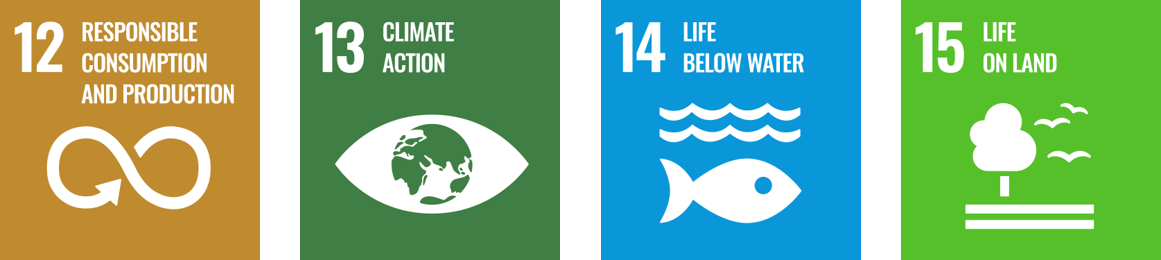
UN Sustainable Development Goals
| SDG Goal |
|---|
| Goal 3 Good Health and Well-being |
| Goal 4 Quality Education |
| Goal 8 Decent Work and Economic Growth |
| Goal 12 Responsible Consumption and Production |
| Goal 13 Climate Action |
| Goal 14 Life below Water |
| Goal 15 Life on Land |
Policy Review
Policy Reviewed This Year
Yes
Policy Changed This Year
No
Review Details
The Company has adjusted the scope of data for the group of companies to align with the current status. In 2026, there was an adjustment of vessel data in the fleet, and data from V.C. Shipping and Logistics Co., Ltd. was fully collected.
Business Value Chain
Value Chain Description
The Company has considered various important factors that enable it to conduct business according to good governance principles and develop sustainably. Therefore, the Company has developed a Stakeholder Management plan for each group that is crucial to the Company's operations, in order to assess the importance and relationships within the business's value chain and analyze risks to consider the comprehensive impact on stakeholders. This is to strengthen relationships with stakeholders in accordance with good corporate governance principles, as well as to foster awareness among employees at all levels to ensure genuine implementation.
Stakeholder Analysis
Introduction
The Group of Companies provides comprehensive marine transportation and storage services for crude oil, refined petroleum products, and liquid petrochemicals to its customers. This also encompasses the provision of support vessels for offshore petroleum exploration and production activities, as well as vessel management. The business value chain is as follows:
Stakeholder Analysis
| Stakeholder Type | Stakeholders | Stakeholder Expectations | Response to Expectations | Communication Activities |
|---|---|---|---|---|
| External stakeholders | 2904 · Description: Investors or investment institutions · 2913 · Description: Shareholders | • Shareholders/investors are accurately and completely informed of the company's performance and future growth trends.
• Shareholders are treated equally, transparently, and fairly, and their rights are respected.
• There is good management and corporate governance that is transparent and verifiable.
• There is business growth, risk and opportunity management to generate good long-term returns.
• Business operations consider stakeholders and are responsible towards the environment, society, and corporate governance. | • Treat shareholders equally, transparently, and fairly.
• Perform duties with honesty, transparency, and fairness, and manage the company in accordance with laws, objectives, company regulations, resolutions of shareholders' meetings, and good corporate governance principles.
• Perform duties with full knowledge and ability, with responsibility, prudence, and without seeking undue benefits for oneself or others.
• Disclose material information of the company to shareholders adequately, equally, accurately, and in a timely manner. | 2938 · Description: Visit · 2941 · Description: Online Communication · 2944 · Description: Annual General Meeting (AGM) · 2945 · Description: Complaint Reception · 2949 · Other name: Management's Discussion and Analysis (MD&A) via the stock exchange and the company's website quarterly. · Description: Others · 2949 · Other name: Activities for listed companies to present operating results and business outlook to investors (Road Show) · Description: Others · 2949 · Other name: Hold quarterly Analyst Meetings for analysts and fund managers. · Description: Others · 2949 · Other name: Quarterly Listed Company Investor Meeting (Opportunity Day) of the Stock Exchange · Description: Others |
| Internal stakeholders | 2921 · Description: Employees | • Good, appropriate, and fair compensation, welfare, and benefits.
• A good and safe working environment.
• Fair appointments, transfers, rewards, and disciplinary actions .
• Continuous development of employees' knowledge, skills, and potential according to their operational roles
• Listen to and understand incidents, and provide full support and assistance.
• Ensure job security and career advancement. • Receive information or updates regarding the company. | - Provide appropriate and fair welfare and compensation.
- Maintain a safe working environment for employees' lives and property.
- Establish performance indicators for transparent performance evaluation.
- Establish an annual training plan for employees in each department, covering basic skills, management skills, and appropriate professional knowledge.
- Provide channels for feedback or reporting violations of regulations or illegal acts.
- Avoid any unfair actions that may affect job security, and refrain from threatening or pressuring employees' mental well-being.
- Inform employees of useful information via company email. | 2942 · Description: Internal Meeting · 2945 · Description: Complaint Reception · 2946 · Description: Employee Engagement Survey · 2948 · Description: Training / Seminar · 2949 · Other name: Executive Meeting with Employees (Town Hall) · Description: Others · 2949 · Other name: Communication via Intranet, company email, and company social network · Description: Others |
| External stakeholders | 2894 · Description: Creditor · 2925 · Description: Financial institution | • To be treated fairly, transparently, and accountably.
• Strict adherence to agreed-upon terms and/or conditions.
• Accurate and complete compliance with credit agreement terms.
• To receive accurate, complete, and factual information | • Not to demand, accept, or agree to accept, nor to give or agree to give, any dishonest benefits or benefits not in accordance with trade customs to creditors.
• To conduct commercial negotiations that are not exploitative, transparent, and fair.
• To pay principal, interest, or manage collateral in accordance with the terms of the contract.
• To strictly adhere to the agreed terms and/or conditions. In the event of an impediment preventing compliance, creditors must be informed, and joint solutions must be sought to ensure that creditors receive performance results equivalent or as close as possible to what was agreed upon. To provide accurate and factual information about the company to creditors. | 2938 · Description: Visit · 2941 · Description: Online Communication · 2949 · Other name: Meeting with creditors · Description: Others · 2949 · Other name: Analysts' Meeting · Description: Others |
| External stakeholders | 2899 · Description: Suppliers | • Fair, transparent, verifiable, and non-exploitative selection of partners.
• Strict adherence to mutually agreed-upon agreements and/or conditions.
• The Company supports and enhances partners' operations to foster optimal cooperation.
• Provision of accurate, complete, and factual information.
• Sharing of knowledge and co-creation of innovation for the benefit of all parties. | • Establish systematic operating procedures and review them at least once a year.
• Conduct fair competitive bidding among partners under the company's price comparison criteria.
• Maintain and protect information between the company and its partners.
• Prepare a Tanker Management and Self-Assessment (TMSA) once a year.
• Not to solicit, accept, or agree to accept, nor to offer or agree to offer, any dishonest benefits or those not in accordance with customary trade practices with partners.
• Commercial negotiations with partners must not be exploitative, but transparent and fair.
• Strictly adhere to agreed-upon terms and/or conditions, clearly define the scope of operations, and ensure services or payments are made within the specified timeframe. | 2941 · Description: Online Communication · 2945 · Description: Complaint Reception · 2949 · Other name: Supplier Day Meeting · Description: Others |
| External stakeholders | 2923 · Description: Customers | • Quality and standardized services that meet customer needs.
• Providing accurate, complete, and factual information.
• Listening to and resolving issues arising from service use.
• Protecting customer data or confidentiality
• Providing innovations that meet customer needs .
• Maintaining good relationships and equal treatment | • Provide quality services by defining service quality levels and standards, strictly adhering to conditions, commitments, or offers made to customers, and maintaining service quality standards in accordance with international standards.
• Disclose complete and factual information regarding the Group's projects and various services, and refrain from advertising or promoting projects in a manner that misleads customers.
• Establish a complaint handling system to receive feedback and suggestions from customers regarding the Group's various services, and to resolve or clarify the outcomes of actions taken concerning such complaints to customers.
• Conduct customer satisfaction surveys once a year. • Implement measures to protect customer data and confidentiality.
• Promote and facilitate service innovation to ensure customers receive benefits and satisfaction. | 2945 · Description: Complaint Reception · 2947 · Description: Satisfaction Survey · 2949 · Other name: Direct customer meetings/discussions · Description: Others · 2949 · Other name: Customer Relations System Email: PRMoperation@primamarine.co.th · Description: Others |
| External stakeholders | 2898 · Description: Competitors | • Conducting business within the framework of laws and fair competition.
• Operating business with honesty and integrity..
• Not damaging the reputation of competitors. | • Conduct business and compete within the framework of laws and fair competition rules.
• Do not seek confidential information of trade competitors through dishonest or inappropriate means.
• Do not attempt to damage the reputation of trade competitors by making malicious accusations without factual basis. | 2943 · Description: External Meeting · 2949 · Other name: Network collaboration in accordance with government policy. · Description: Others |
| External stakeholders | 2931 · Description: Government agencies and Regulators | - Compliance with laws, rules, and relevant regulations of government agencies - Cooperation with government agencies | • Heed opinions and recommendations from the public sector.
• Share insights from the private sector with the public sector to foster a better understanding of business operations.
• Cooperate with government agencies responsible for overseeing the Company's business operations.
• Strictly adhere to laws, regulations, and guidelines issued by the public sector. | 2941 · Description: Online Communication · 2949 · Other name: Support for public benefit projects · Description: Others · 2949 · Other name: Disclosure of Information or Cooperation · Description: Others |
| External stakeholders | 2902 · Description: Community · 2928 · Description: Society | • Conduct business responsibly, without causing harm to the community, society, and environment.
• Operate under laws, regulations, and the ethical principles of society.
• Understand the community and listen to its opinions, as well as jointly develop the quality of life for the community and society.
• Communicate information and foster understanding regarding the company's business operations. | • Visit communities as appropriate to listen to their opinions, needs, and suggestions.
• Participate in problem-solving and support projects beneficial to the community, society, and the environment.
• Refrain from any actions that may cause harm to the community and society, and strictly comply with laws and regulations related to business operations.
• Regularly communicate information regarding the company's business operations. | 2940 · Description: Social Event · 2941 · Description: Online Communication · 2942 · Description: Internal Meeting · 2943 · Description: External Meeting · 2945 · Description: Complaint Reception |
Environmental Sustainability — Overview
Operating Results — Introduction
The Company has prioritized approaches to environmental and energy management by communicating and raising awareness and understanding among executives and employees at all levels regarding greenhouse gas emission reduction, climate change, waste management, and the reduction of significant environmental impacts from the Company's business operations through internal activities and communications. 100% of executives and employees have been informed about policies and activities related to energy and environmental conservation, in line with the Company's declared intention to achieve Carbon Neutrality for Scope 1 and 2 by 2030 and to strive for Net Zero greenhouse gas emissions by 2050.
Environmental Policy & Guidelines
Has an Environmental Policy
Yes
Policy Description
The Company is committed to implementing environmental projects and continuously striving to reduce environmental impacts, such as maximizing energy efficiency. Greenhouse Gas Management or the development of green technology, by continuously controlling operational processes and improving operational efficiency. This enables the Company's personnel to perform their duties effectively, which will benefit the environment and the Company's overall business operations. The Company primarily focuses on reducing greenhouse gas emissions to help slow down climate change and support the government's goal of achieving net-zero greenhouse gas emissions. (Net Zero Emission)
Additionally, the Company has established an environmentally friendly procurement policy in line with socially responsible business practices that lead to sustainable development. This promotes environmentally friendly procurement, including procurement management that reduces environmental impact, to support government environmental management guidelines and drive sustainable production and consumption in society. The Company procures products certified as environmentally friendly, referencing announcements from the Pollution Control Department, in the categories of office supplies (Stationary), consumables, and provisions.
Environmental Guidelines
| Guideline |
|---|
| Electricity Management |
| Fuel Management |
| Water Management |
| Waste Management |
| Greenhouse Gas and Climate Change Management |
Environmental Policy Review
Policy Reviewed This Year
No
Energy — Plan & Guidelines
Has an Energy Management Plan
Yes
Plan Description
The Company has a policy for managing energy consumption by controlling operational processes and improving operational efficiency. It also studies and monitors technologies or innovations related to the business to adapt them to the organizational context, such as engine development. Hybrid which incorporates electric motors and batteries to store electricity and use it as an alternative to fuel energy. The design of the ship's structure aims to reduce resistance from water currents, and the hull shape is optimized for the environment. Additionally, special anti-fouling paint is used to minimize resistance during movement, ensuring the most efficient energy consumption.
Furthermore, the Company continuously monitors news and developments in clean energy that can replace fossil fuels.
Energy — Electricity Consumption
Electricity Consumption
| Metric | Current Year | Previous Year | Two Years Ago |
|---|---|---|---|
| Total electricity consumption within the organization (Kilowatt-Hours) | 454,074.56 | 465,242.22 | 490,025 |
| Electricity purchased for consumption from non-renewable energy sources (Kilowatt-Hours) | 454,074.56 | 465,242.22 | 490,025 |
| Electricity purchased or generated for consumption from renewable energy sources (Kilowatt-Hours) | 0 | 0 | 0 |
Energy — Fuel Consumption
Fuel Consumption
| Metric | Current Year | Previous Year | Two Years Ago |
|---|---|---|---|
| Jet fuel (Litres) | 0 | 0 | 0 |
| Diesel (Litres) | 39,881,835.96 | 39,742,670.96 | 45,812,479.04 |
| Gasoline (Litres) | 159,714.06 | 149,213.13 | 189,055.68 |
| Fuel oil (Litres) | 53,220,361.68 | 53,239,490.19 | 25,796,979.43 |
| Crude oil (Barrels) | 0 | 0 | 0 |
| Natural gas (Standard cubic feet) | 0 | 0 | 0 |
| LPG (Kilograms) | 0 | 0 | 0 |
| Steam (Metric tonnes) | 0 | 0 | 0 |
| Coal (Metric tonnes) | 0 | 0 | 0 |
Energy — Targets
Has Set Targets
Yes
Targets
| Target | Base Year | Base Year Value | Target Year | Target Change (%) | Unit | Unit — Please Specify |
|---|---|---|---|---|---|---|
| Reduction of electricity purchased for consumption | 2,024 | 465,242.22 | 2,025 | 5 | Kilowatt-hour | |
| Reduction of fuel consumption | 2,024 | 93,261,911.7 | 2,025 | 10 | Others | Tonne |
Energy — Performance & Outcomes
Has Performance Results
Yes
Performance Description
Fuel Energy
To align with the Scope 1 greenhouse gas emission reduction target for 2025, the Company has set a goal to reduce energy consumption from vessel operations during the Off-hire by 10 percent through efficient control of vessel operating time, such as planning dry docking for scheduled maintenance (Preventive Maintenance System: PMS) to ensure maximum maintenance efficiency within a limited timeframe, and managing the timing of vessel voyages to destinations to enable immediate cargo handling for customers.
In 2025, the Company consumed fuel, categorized as 39,881,835.96 liters of diesel, 159,714.06 liters of gasoline, and 53,220,361.68 liters of fuel oil, totaling the entire fuel consumption. 93,261,911.70 liters, an increase of 0.14 percent from the base year (2024), due to an increase in personnel and adjustments to the vessel dry-docking schedule.
The fuel volume is currently under verification. Should the volume change after verification, the Company will inform through the Stock Exchange channels accordingly.
Electricity
The Company aims to reduce electricity consumption by 5 percent compared to 2024 through a campaign to reduce electricity use in the office. The Company has seriously begun organizing meetings in accordance with the Green Meeting guidelines, coupled with a policy to reduce paper usage to decrease energy consumption for document printing. This also includes setting air conditioner temperatures at 25 degrees Celsius, alongside a campaign encouraging appropriate attire for the meeting room environment. Furthermore, the Company promotes turning off lights during lunch breaks to foster a habit of electricity conservation.
In 2025, the Company consumed 454,074.56 kilowatt-hours, a decrease of 2.4 percent. compared to the base year (2024).
Water — Plan & Guidelines
Has a Water Management Plan
Yes
Plan Description
To mitigate environmental impact, the Company acknowledges the potential effects of its water consumption. Consequently, water usage is managed efficiently, and wastewater is handled in accordance with established standards. The Company encourages all executives and employees to recognize the value of water and to use it judiciously. This is achieved through office campaigns promoting mindful water usage among staff. Monthly reports on building water consumption are provided to enhance employee awareness and cultivate habits of economical water use. Furthermore, water pipes in restrooms and kitchens are regularly maintained in optimal condition to consistently prevent leaks.
Water — Withdrawal, Discharge & Consumption
Water Withdrawal, Discharge & Consumption
| Metric | Current Year | Previous Year | Two Years Ago |
|---|---|---|---|
| Total water withdrawal (Cubic meters) | 4,663.28 | 3,788.68 | 3,262 |
| Total water withdrawal by third-party water (Cubic meters) | 4,663.28 | 3,788.68 | 3,262 |
| Total water withdrawal by surface water (Cubic meters) | 0 | 0 | 0 |
| Total water withdrawal by groundwater (Cubic meters) | 0 | 0 | 0 |
| Total water withdrawal by seawater (Cubic meters) | 0 | 0 | 0 |
| Total water withdrawal by produced water (Cubic meters) | 0 | 0 | 0 |
| Percentage of wastewater treated before discharge (%) | 100 | 100 | 100 |
| Total water discharge (Cubic meters) | 4,663.28 | 3,788.68 | 3,262 |
| Total water discharge to third-party water (Cubic meters) | 4,663.28 | 3,788.68 | 3,262 |
| Total water discharge to surface water (Cubic meters) | 0 | 0 | 0 |
| Total water discharge to groundwater (Cubic meters) | 0 | 0 | 0 |
| Total water discharge to seawater (Cubic meters) | 0 | 0 | 0 |
| Total water consumption (Cubic meters) | 0 | 0 | 0 |
| Recycled water (Cubic meters) | 0 | 0 | 0 |
Water — Targets
Has Set Targets
Yes
Targets
| Target | Base Year | Base Year Value | Target Year | Target Change (%) | Unit |
|---|---|---|---|---|---|
| Reduction of water withdrawal | 2,024 | 3,788.68 | 2,025 | 3 | Cubic meters |
Water — Performance & Outcomes
Has Performance Results
No
Performance Description
The Company continues to promote water conservation among its employees. In 2025, the water consumption volume was 4,663.28 cubic meters increased by 23.08 percent compared to the base year (2024). This is because in 2025, the Company expanded its data collection scope to include the office buildings of V.C. Shipping and Service Co., Ltd., resulting in a significant increase in the number of employees, which consequently led to water consumption not meeting the target.
Additionally, the Company has installed wastewater treatment systems in compliance with regulations, including the installation of grease traps for all office buildings and ballast water treatment systems for all target vessels. Furthermore, wastewater generated from onboard consumption is treated according to standards to prevent contamination before discharge into the sea in designated areas.
Waste — Plan & Guidelines
Has a Waste Management Plan
Yes
Plan Description
The company prioritizes waste and refuse management, with clear segregation of waste and refuse to ensure proper disposal, categorized as follows:
Ships must strictly comply with the requirements of the International Convention for the Prevention of Pollution from Ships (MARPOL) by:
Sewage is managed according to the requirements of Annex IV, Prevention of Pollution by Sewage from Ships, which mandates the presence of a certified Sewage Treatment Plant, a Sewage Comminuting and Disinfecting System, and a certified Holding Tank. In the event of a spill, it must be recorded in the Garbage Record Book.
Waste is segregated according to the requirements of Annex V, Prevention of Pollution by Garbage from Ships, categorized into Food wastes, Domestic wastes, Operational wastes, Plastic, Cargo residues, Incinerator ashes, Cooking oil, Fishing gear, Animal carcasses, and items generated from the normal operation of the ship that must be disposed of regularly or periodically. Additionally, a Garbage Management Plan and a Garbage Record Book must be maintained to strictly record and control waste disposal.
All waste generated from ships will be handed over to partners certified by the Marine Department for proper disposal in accordance with standards.
Offices segregate waste into categories: general waste, food waste or wet waste, recyclable waste, hazardous waste, and infectious waste. Additionally, campaigns are organized to utilize recyclable waste for further benefit.
Waste — Generation, Disposal & Recycling
Waste Generation, Disposal & Recycling
| Metric | Current Year | Previous Year | Two Years Ago | Remark |
|---|---|---|---|---|
| Total waste generated (Kilograms) | 283,339.23 | 7,445.06 | 6,410.15 | |
| Non-hazardous waste (Kilograms) | 283,339.23 | 7,445.06 | 6,410.15 | The year 2025 marks the first year that waste from vessels has been included, resulting in a significant increase in volume. |
| Non-hazardous waste - Landfilling (Kilograms) | 275,451.33 | 5,970.32 | 5,814 | |
| Non-hazardous waste - Incineration (with energy recovery) (Kilograms) | 0 | 0 | 0 | |
| Non-hazardous waste - Incineration (without energy recovery) (Kilograms) | 0 | 0 | 0 | |
| Non-hazardous waste - Other disposal operations (Kilograms) | 7,887.9 | 1,474.74 | 596.15 | Collection of recyclable waste and wet waste, with 2025 being the first year that food waste (wet waste) from offices will be disposed of by being used as animal feed (not landfilled). |
| Hazardous waste (Kilograms) | 0 | 0 | 0 | |
| Hazardous waste - Landfilling (Kilograms) | 0 | 0 | 0 | |
| Hazardous waste - Incineration (with energy recovery) (Kilograms) | 0 | 0 | 0 | |
| Hazardous waste - Incineration (without energy recovery) (Kilograms) | 0 | 0 | 0 | |
| Hazardous waste - Other disposal operations (Kilograms) | 0 | 0 | 0 | |
| Total reused/recycled waste (Kilograms) | 1,946.11 | 2,326.2 | 596.15 | Volume of recycled waste only, excluding wet waste. |
| Reused/Recycled non-hazardous waste (Kilograms) | 1,946.11 | 2,326.2 | 596.15 | |
| Reused non-hazardous waste (Kilograms) | 0 | 0 | 0 | |
| Recycled non-hazardous waste (Kilograms) | 1,946.11 | 2,326.2 | 596.15 | |
| Reused/Recycled hazardous waste (Kilograms) | 0 | 0 | 0 | |
| Reused hazardous waste (Kilograms) | 0 | 0 | 0 | |
| Recycled hazardous waste (Kilograms) | 0 | 0 | 0 |
Waste — Targets
Has Set Targets
Yes
Targets
| Waste Type | Disposal Approach | Target | Base Year | Base Year Value | Target Year | Target Change (%) | Unit |
|---|---|---|---|---|---|---|---|
| Non-hazardous waste | 2758 · Description: Reuse · 2759 · Description: Recycle · 2763 · Other name: Reduce usage · Description: Other | Reduce waste volume | 2,024 | 5,970.32 | 2,025 | 3 | Kilograms |
Waste — Performance & Outcomes
Has Performance Results
Yes
Performance Description
In 2025, the total volume of general waste from ships and offices was 275,451.33 kilograms, divided into 6,273.69 kilograms from offices and 269,177.64 kilograms from ships. The company delivered 100% of the waste from ships to its partners. Regarding office waste, general and hazardous waste were sent to municipalities and Sub-district Administrative Organizations (SAO). Recyclable waste was donated to Wat Chak Daeng for management according to the principles of the Circular Economy, and food waste began to be used as animal feed for the first time this year.
Additionally, the company also has projects to collect and dispose of waste from stakeholders, including:
-
Bottle-for-Egg Project and Recyclable Waste Market Project: The company organizes a bottle-for-egg activity, collecting used plastic bottles from employees in exchange for eggs twice a year. It also participates in the Recyclable Waste Market project, exchanging used plastic bottles from the community twice a year. In 2025, a total of 44,944 plastic bottles were donated to Wat Chak Daeng.
-
Old Fishing Net for Cooking Oil Exchange Project: The company exchanges old fishing nets from the community for cooking oil and donates them to Wat Chak Daeng for further recycling. In 2025, a total of 152 kilograms of nets were collected.
-
Oil Containment Boom and Life Jacket Donation Project: The company has been donating unusable oil containment booms and life jackets since 2017, and this initiative has been continuously organized by
In 2025, 50 meters of oil containment booms and 80 life jackets were donated.
-
Our Old Medicine Blister Pack Project: The company collects donated aluminum blister packs from employees and delivers them to Prince Suvarnabhumi Hospital for recycling and production into prosthetic limbs. In 2025, a total of 11.82 kilograms of blister packs were donated.
The company aims to reduce the volume of non-hazardous waste from offices (general waste) that is sent to municipalities for landfill disposal. In 2025, the target was to reduce general office waste by 3%. However, due to the merger with V.C. Shipping and Service Co., Ltd., there was a significant increase in the number of employees, which resulted in a 5.08% increase in waste volume compared to the base year (2024).
GHG — Plan & Guidelines
Has a GHG Management Plan
Yes
Plan Description
The company complies with the requirements of the International Convention for the Prevention of Pollution from Ships ( MARPOL) Annex VI Prevention of Air Pollution from Ships, which focuses on maximizing energy efficiency to reduce greenhouse gas emissions, and new measures for energy efficiency in international shipping, namely the Energy Efficiency Existing Ship Index ( The Energy Efficiency Existing Ship Index: EEXI) which the company comprehensively measures for all vessels in every fleet to confirm fleet standards, and the Carbon Intensity Indicator for ship operations ( Carbon Intensity Indicator: CII) for international vessels with a size of 5,000 gross tonnage and above. Measurements and reports are conducted monthly to monitor and control vessel operations for maximum efficiency.
Furthermore, the company aims to achieve Carbon Neutrality ( Carbon Neutrality) in Scope 1 and 2 by 2030 and aims for Net Zero greenhouse gas emissions ( by 2050. Therefore, the company measures and verifies its greenhouse gas emissions to obtain certification for its Corporate Carbon Footprint ( Carbon Footprint for Organization: CFO) from the Thailand Greenhouse Gas Management Organization (Public Organization) (TGO) annually. The company's greenhouse gas emission data will be used in conjunction with its energy consumption plan to strategize greenhouse gas reduction and serve as a guideline for studying technologies or implementing innovations in the company's operations moving forward.
GHG — Emissions
GHG Emissions
| Metric | Current Year | Previous Year | Two Years Ago |
|---|---|---|---|
| Total GHG emissions (Metric tonnes of carbon dioxide equivalent) | 253,825 | 257,044 | 207,958 |
| Total greenhouse gas emissions 1 (Metric tonnes of carbon dioxide equivalent) | 8,195 | 7,874 | 6,054 |
| Total greenhouse gas emissions 2 (Metric tonnes of carbon dioxide equivalent) | 216 | 233 | 245 |
| Total greenhouse gas emissions 3 (Metric tonnes of carbon dioxide equivalent) | 245,414 | 248,937 | 201,659 |
GHG — Emissions Verification
Emissions Verified by a Third Party
Yes
Verifying Body
2648
GHG — Principles & Standards
Principles & Standards Applied
| Standard | Other — Please Specify |
|---|---|
| 2671 | |
| 2734 | International Maritime Organization |
GHG — Targets
Has Set GHG Targets
Yes
GHG Targets — Net Zero
Net Zero Targets
| Emission Scope | Base Year | Base Year Emissions | Near-term Target Year | Near-term Target Value | Long-term Target Year | Long-term Target Change (%) | Target Year | Target Year Emissions | Unit |
|---|---|---|---|---|---|---|---|---|---|
| 2716 | 2,024 | 257,044 | 2,030 | 8,107 | 2,050 | 100 | 2,030 | 8,107 | Metric tonnes of carbon dioxide equivalent |
GHG Targets — Carbon Neutrality
Carbon Neutrality Targets
| Emission Scope | Carbon Neutrality Certified | Base Year | Base Year Emissions | Target Year | Target Change (%) | Unit |
|---|---|---|---|---|---|---|
| 2715 | N | 2,024 | 8,107 | 2,030 | 100 | Metric tonnes of carbon dioxide equivalent |
GHG — Performance & Outcomes
Has Performance Results
Yes
Performance Description
year 2568 The Company measures carbon emissions and receives data verification from Bureau Veritas Certification (Thailand) Co., Ltd. and has received corporate carbon footprint certification ( CFO) from the Thailand Greenhouse Gas Management Organization (Public Organization) Public Company Limited) with the scope of measurement being office buildings 8 locations and vessels 62 vessels has total greenhouse gas emissions of 253,825 tons of carbon dioxide equivalent decreased by 1.3% from the base year (2024) Divided by scope as follows:
|
Quantity for 2025 ( tons of carbon dioxide equivalent ) |
Proportion compared to the base year (2024) |
|
|
Scope 1 |
8,195 |
increased by 3.9% due to adjustments in the vessel dry-docking schedule. |
|
Scope 2 |
216 |
decreased by 7.9% |
|
Scope 3 |
245,414 |
decreased by 1.4% |
The greenhouse gas emissions are currently undergoing verification. Should the amount change after verification and certification, the Company will inform the public via the Stock Exchange channels.
Currently, the Company is studying various technologies and innovations to incorporate into its greenhouse gas reduction plan. The initial measure involves offsetting emitted greenhouse gases by purchasing carbon credits, for which the Company organizes activities in the form of Carbon Neutral Event which involves measuring the amount of greenhouse gases emitted from each activity and purchasing carbon credits to offset those emissions to zero. A total of 4 activities, including Prima Volunteer Year 5: Building Homes for Fish, Cultivating Condos for Crabs, and Creating Living Walls to Restore Nature to the Community (Mangrove Planting), Enterprise Risk Management Seminar, and the Annual Crew Conference 2025 and purchased a total of carbon credits for offsetting. 40 tons of carbon dioxide equivalent
Environmental Legal Incidents
Number of Incidents — Introduction
The Company operates in compliance with environmental regulations and laws in all areas where it conducts business to prevent adverse impacts on the environment and society. Therefore, a target has been set for zero environmental impact complaints and zero baht for environmental fine expenses.
In 2025, environmental impact complaints are zero cases, and environmental fine expenses are zero baht.
Legal Violation Incidents
| Metric | Current Year | Previous Year | Two Years Ago |
|---|---|---|---|
| Number of cases or incidents of legal violations or negative environmental impact (cases) | 0 | 0 | 0 |
Other Environmental Management
Plan Description
Green Procurement The Company has operational guidelines to lead the organization in implementing and promoting green procurement in alignment with its sustainable development policy. The Company annually reviews the list of environmentally labeled products in its regular procurement list and encourages employees to select products from this list to ensure the economical and optimal utilization of resources and to minimize environmental impact throughout the supply chain. By 2025, the Company will support the use of products that utilize renewable resources and do not cause environmental pollution, such as products certified with a green label. The Company considers business partners with certified environmental quality standards, selecting energy-efficient equipment or technologies that reduce environmental impact. Furthermore, it surveys sustainability performance through questionnaires and requests supporting documentation from 80% of its most transacted business partners. Additionally, the Company plans site visits to assess business partners' operational areas, including social and environmental aspects in the evaluation.
Employees — Plan & Guidelines
Has an Employee Management Plan
Yes
Plan Description
Fair employee remuneration.
The Company establishes criteria for salary adjustments and annual bonus payments, primarily based on employee performance, through Individual Key Performance Indicators (KPIs) linked to departmental and organizational goals, coupled with Performance Appraisal (APA). This ensures that the remuneration consideration process is transparent, fair, and appropriately reflects performance. The Company sets remuneration criteria by considering the quality of life of employees, as well as cost of living factors and benchmarking against the same industry, to ensure employees receive fair and appropriate compensation sufficient for their livelihood.
Employee training and development.
The Company provides opportunities and supports the development of employee potential according to their career paths. Courses are designed to suit each group of learners based on their career paths, including developing employees into high-potential (Talent) groups to create specialists in their fields and successor groups to prepare them for important positions in the future. The development approaches are as follows:
annual and career-path training.
Organizational Leadership Development Program (Leadership Program)
Promoting employee relations and engagement.
The Company places importance on promoting employee relations and engagement within the organization. Therefore, it actively solicits employee feedback to continuously develop and improve the working environment, by organizing activities and operational guidelines as follows:
Organize Happy Workplace activities covering all 8 aspects: Happy Body, Happy Heart, Happy Society, Happy Relax, Happy Brain, Happy Soul, Happy Money, and Happy Family, which help promote stable physical and mental health for employees, and foster good relationships and engagement among employees at all levels.
Employee Engagement Surveys and Employee Satisfaction Surveys are conducted twice a year to gather feedback, expectations, and experiences from all employees. The results from the employee engagement surveys will be analyzed to improve the working environment and further develop human resources policies.
establish a secure and private channel for complaints, enabling employees to report issues safely.
Foreign workers
The Company provides care for migrant workers in accordance with its human rights policy, which covers treating everyone equally based on human rights principles without discrimination, by providing equal and fair welfare benefits, and by setting remuneration in compliance with labor laws and immigration laws. as well as managing related documents in accordance with the law. to ensure that the employment and care of migrant workers are in accordance with the law.
Occupational safety and health.
The Company to ensure the state of important with the state of safety in establishment which perform work is thoroughly increasingly, therefore systematically and continuously strengthen and drive a safety culture under the supervision of senior management throughout the year by provide provide has C committee committee the state of safety, occu- bio Wor na hygiene and conditions environment in the act of perform work (C P.O.) and has committee perform 5S activities to to ensure that employees work with the state of safety and health hygiene which good in establishment operations, with the act of provide perform manual the state of to due to channel business (Business Continuity Management Manual) has the act of create culture the state of safety through the act of communication, the provide the state of knowledge and the act of share data which related with the state of comprehensive safety in the workplace and social conditions. to ensure that the act of conduct work of Company etc. to ensure is to thoroughly has efficiency, in accordance with the O specified standards and relevant laws.
In addition, the Company has established the Safety, Security, Health, and Environment Committee of PRM Fleet to systematically oversee and manage the fleet's operations to reduce or prevent accidents. Senior executives from various departments regularly attend meetings, and the Chief Executive Officer (CEO) chairs these meetings to seriously drive safety policies and decisions. An annual Safety Campaign is also organized to continuously promote and elevate the safety culture under the "Zero Incident & Zero Breakdown" policy. Furthermore, the Company regularly analyzes accident and near-miss data to apply lessons learned in improving preventive measures, hazard communication, and developing more efficient and safer work processes in practice.
Plan Areas
| Plan Area |
|---|
| Fair employee compensation |
| Employee training and development |
| Promoting employee relations and participation |
| Migrant/foreign labor |
| Occupational health and safety in workplace |
Employees — Workforce
Workforce — Introduction
As of December 31, 2025, the Company and its subsidiaries have a total of 1,528 personnel (excluding directors and executives as defined in the Securities and Exchange Commission's notification), consisting of: 1) 300 permanent employees of the Company and its domestic subsidiaries, 2) 24 employees of foreign subsidiaries, and 3) 1,204 crew members, comprising 230 permanent employees and 974 contract employees.
Workforce Data
| Metric | Current Year | Previous Year | Two Years Ago | Remark |
|---|---|---|---|---|
| Total number of employees (Persons) | 554 | 226 | 232 | Number of office-based employees of the Company and its subsidiaries 324 people and Seafarer 230 people. |
| Number of male employees (Persons) | 378 | 96 | 97 | *All crew members are male. **The ratio of male employees to female employees is 2.14 : 1. |
| Number of female employees (Persons) | 176 | 130 | 135 | |
| Total employment of disabled persons (people) | 0 | 0 | 0 | |
| Total disabled employees (people) | 0 | 0 | 0 | |
| Total male disabled employees (people) | 0 | 0 | 0 | |
| Total female disabled employees (people) | 0 | 0 | 0 | |
| Total disabled workers who are non-employee (people) | 0 | 0 | 0 | |
| Contributions to the fund for promoting and improving the quality of life for disabled persons | 1 | 1 | 1 | In 2025, the Company did not employ persons with disabilities and contributed 123,005 Baht to the Fund for the Promotion and Development of the Quality of Life for Persons with Disabilities for the 5th consecutive year. |
| Total number of male employees in operational level (Persons) | 315 | 66 | 66 | |
| Total number of male employees in management level (Persons) | 52 | 23 | 24 | |
| Total number of male employees in executive level (Persons) | 11 | 7 | 7 | |
| Total number of female employees in operational level (Persons) | 146 | 105 | 109 | |
| Total number of female employees in management level (Persons) | 25 | 21 | 23 | |
| Total number of female employees in executive level (Persons) | 5 | 4 | 3 |
Employees — Remuneration & Provident Fund
Introduction
The Company has criteria for considering annual salaries and bonuses for employees, which are assessed based on Individual Key Performance Indicators (Individual KPI) that align and link with departmental and organizational-level indicators, and Performance Appraisal (APA). Additionally, an annual Salary Survey is continuously conducted within the same industry to ensure that employee compensation remains competitive within the industry group and fair to employees, taking into account factors such as qualifications, experience, responsibilities, and business suitability. For the year 2025, employee compensation (excluding executives) for permanent employees of the Group (including overseas subsidiaries) and seafarers totaled 556.62 million Baht, and total employee benefits for the Group amounted to 1,489.53 million Baht.
The Company has a higher compensation rate for male employees than female employees, as specialized positions in the shipping business line offer higher compensation rates than general positions. Most of the Company's male employees hold such positions, and all seafarers are male. The company reports a higher compensation rate for male employees compared to female employees. This disparity arises because specialized positions in the shipping industry, which offer higher pay than general positions, are predominantly held by male employees, including the entire crew. The maritime shipping industry is currently evolving to promote the recruitment of women into these specialized roles. The company remains committed to supporting greater representation of female employees in specialized positions within the shipping industry.
Remuneration & Provident Fund
| Metric | Current Year | Previous Year | Two Years Ago | Remark |
|---|---|---|---|---|
| Total disabled employees (people) | 556,617,878.55 | 317,204,880.84 | 306,839,523.64 | Year 2025: Compensation for permanent employees of the Group (including overseas subsidiaries) and crew members (excluding executives) of the Company. |
| Total male employee remuneration (Baht) | 394,501,219.75 | 186,176,457.52 | 183,330,082.94 | Male compensation rate is 2.43 times the female compensation rate. |
| Total female employee remuneration (Baht) | 162,116,658.8 | 131,028,423.32 | 123,509,440.7 | |
| Number of employees eligible to participate in PVD (persons) | 300 | 226 | 232 | Calculations are only for the Company's permanent employees and for its subsidiaries established in Thailand. (Excluding Seafarers) |
| Total number of employees joining employee provident fund (Persons) | 256 | 208 | 198 | Calculations are only for the Company's permanent employees and for its subsidiaries established in Thailand. (Excluding Seafarers) |
| Percentage of total number of employees joining employee provident fund to total number of employees (%) | 46.21 | 92.04 | 85.34 | |
| Number of PVD members / Total eligible employees (%) | 85.33 | 92.04 | 85.34 | |
| Total amount of provident fund contributed by the Company (Baht) | 9,405,964 | 9,470,440 | 9,032,554 | |
| Total amount of provident fund contributed by employee (baht) |
Employees — Training & Development
Introduction
The Company The Company places importance on continuous training and development of personnel throughout their employment, with development processes from onboarding to retirement. This includes new employee orientation, on-the-job training, annual and career-path specific training, as well as potential development for supervisory and management-level employees, to enhance knowledge, skills, and abilities aligned with the Company's business strategies and direction. etc.
In 2025, the Company systematically conducted personnel training and development according to plan, covering employees at all levels and in all departments. This included both skills-based training and seminars to enhance knowledge and awareness in various areas, such as leadership and management skill development, effective work and communication skills, financial knowledge, risk management, sustainability, information technology, and occupational safety. The Company The Company has a total of personnel development hours 17,076.58 hours, reflecting its commitment to continuously enhancing personnel potential.
Additionally, the Company The Company has begun implementing an e-learning system as part of its personnel development. A pilot project was conducted in collaboration with the SkillLane platform to provide employees with continuous and flexible opportunities to learn and develop skills according to individual suitability, covering work skills, digital skills, and business-related knowledge. Following the results of this project, the Company has expanded the use of the e-learning system as part of its long-term personnel development plan, focusing on developing high-potential employees (Talent) within the organization through learning programs designed to align with career paths and organizational needs. This aims to prepare them with the skills and potential for future business growth and to support the creation of a sustainable learning organization.
The Company The Company also places importance on good corporate governance and ethical business operations, incorporating anti-corruption content as part of new employee orientation and regularly providing anti-corruption training, including has training courses on Information Technology Security Awareness, internal data usage policies, and Personal Data Protection Act (PDPA) policies, as well as relevant standard requirements, to ensure that employees at all levels possess knowledge, understanding, and awareness of their responsibility to operate transparently and sustainably, while also promoting knowledge transfer and collaborative learning to foster a Learning Organization.
Training Data
| Metric | Current Year | Previous Year | Two Years Ago |
|---|---|---|---|
| Average employee training hours (Hours / Person / Year) | 56.92 | 63.69 | 52.34 |
| Employee development and training expenses (baht) | 8,271,452.58 | 7,169,287.17 | 5,476,166.48 |
Employees — Occupational Health & Safety
Occupational Health & Safety Data
| Metric | Current Year | Previous Year | Two Years Ago |
|---|---|---|---|
| Total number of lost time injury incidents by employees (Cases) | 0 | 0 | 0 |
Employees — Labour Relations
Introduction
The Company has established a statutory Welfare Committee, elected by employees throughout the organization, with committee member qualifications determined by the diversity of job functions and professions.
Labour Relations — Introduction
Employee engagement is a crucial driver of business success and organizational effectiveness. Therefore, the Company must foster strong relationships between employees and the organization to ensure effective collaboration in work and problem-solving. The Company is committed to managing human resources to provide employees with career advancement opportunities and to build strong bonds between employees and the organization.
The Company conducted an organizational engagement survey ( Employee Engagement Survey) Number of 2 Round and to utilize Survey results and feedback received for immediate analysis, development, and problem resolution. by in the year 2025 The average employee engagement assessment result is 89.7 percent.
The total employee turnover rate for the company is 0.80%, based on the number of employees as of January 1, 2025, and the number of employee changes resulting from new hires, resignations, and internal transfers within the group from January to December 2025. This turnover rate is below the established target of 2% or less, indicating effective human resource management, strong employee retention, and high levels of employee engagement. Voluntary resignations represented 84% of all employee turnover.
Labour Relations Data
| Metric | Current Year | Previous Year | Two Years Ago | Remark |
|---|---|---|---|---|
| Total voluntary resignations (Persons) | 21 | 25 | 17 | A total of 25 employees resigned. |
| Male employees who voluntary resigned (Persons) | 14 | 10 | 6 | |
| Female employees who voluntary resigned (Persons) | 7 | 15 | 11 | |
| Percentage of employee turnover leaving the Company voluntarily (%) | 84 | 11.06 | 7.33 | Calculate the proportion from total employee resignations / number of voluntary employee resignations |
| Evaluation result of employee engagement | 1 | 1 | 1 |
Employees — Employee Representation
Employees Are Represented Collectively
Yes
Forms of Representation
| Form |
|---|
| Welfare committee |
Employees — Targets
Has Set Employee Targets
Yes
Targets
| Indicator | Target Areas | Base Year | Target Year | Target Year — Description |
|---|---|---|---|---|
| Employee Engagement | 2985 · Description: Promoting employee relations and participation | 2,025 | Average employee engagement assessment results of at least 80% | |
| Employee training hours | 2984 · Description: Employee training and development | 2,025 | Average training hours: 12 hours/person/year | |
| Number of Employees | 2984 · Description: Employee training and development | 2,025 | Number of high-potential and succession employees who received 100% training. | |
| Percentage of voluntary employee turnover | 2990 · Other name: Employee turnover rate · Description: Others | 2,024 | 2,025 | Less than or equal to 2% |
Employees — Performance & Outcomes
Has Performance Results
Yes
Performance Description
Employee Training and Development
In 2025, employees at all levels had the opportunity to participate in annual planned training comprehensively. The Company organized 32 annual planned training courses. courses, with an average of 56.92 hours per person per year, which exceeds the target of 12 hours per person per year. Furthermore, the Company organizes courses to prepare high-potential employees. (Talent) and successor groups. (Successor) systematically, including:
courses Leadership Development Program
courses Middle-Management Development Program
High-potential employee group (Talent) and successor groups. (Successor) a total of 79 people attended the training, representing 100% of the target. The feedback for the courses was positive, with an average satisfaction score of 89% from both courses.
Promoting Employee Relationships and Engagement
The Company assesses employee engagement by The employee engagement assessment results for 2025 showed 97.44% for office employees and 82% for seafarers, averaging 89.7%, which exceeds the target of greater than or equal to 80%. These results will be used to analyze and improve the working environment, welfare, and further develop human resources policies.
Office
The Company organized a project Happy Workplace, which consists of activities that promote the quality of work and employee well-being, as well as collaborative activities. resulting in good relationships and a positive work environment. which the Company supports employees participated in activities comprehensively. In 2025, activities were increased based on the results of the 2024 annual engagement survey. to develop, which is an activity focused on mental health care, creating relaxation at work, coupled with enhancing positive work experiences, including:
For mental health and self-development lectures, experts in psychology and personal development were invited to speak on topics that help employees apply knowledge to their work and daily lives, such as "Healing Yourself, Energizing Work" by Khun Khuean Phattaradanai, and "New Balance for Modern Workers" by Ajarn Beer Khon Tuean Tham.
The organization of projects and activities Happy Workplace continuously throughout 2025 to create a friendly atmosphere, support good relationships among colleagues, and help reduce work-related stress.
Seafarers
Based on the results of the 2025 engagement survey, the Company has provided additional accident insurance to all seafarers to elevate coverage beyond basic insurance in accordance with maritime transport industry standards, reflecting a tangible commitment to the safety and quality of life of seafarers. Additionally, the Company has enhanced preventive healthcare for seafarers by expanding the scope of health check-up programs through Medisea to cover more items than the minimum standards required by law and maritime regulations, enabling comprehensive health risk screening. This approach helps build confidence for employees and their families, as well as supports long-term operational readiness.
Furthermore, the Company links safety projects with onboard welfare. Awards received from the Safety Campaign project are utilized as Welfare on Board according to management's objectives, such as purchasing food and facilities for seafarers to engage in joint activities, thereby strengthening relationships and boosting morale in their work.
In terms of potential development, the Company organizes monthly in-house training for seafarers, providing support for food, accommodation, and facilities to enable employees to fully participate in training and knowledge development. This is coupled with the annual Crew Seminar, which serves as a platform for seafarers to exchange experiences, listen to lectures from expert speakers on topics related to safety, self-development, and work-related stress management. It also includes team-building activities, knowledge-enhancing games, and awards for ships and seafarers with outstanding annual performance, as well as social events to strengthen the bond between seafarers and the organization. This approach reflects the Company's commitment to comprehensively caring for seafarers in terms of safety, welfare, potential development, and organizational engagement, to support sustainable long-term growth together.
Voluntary Employee Turnover
In 2025, 25 employees resigned, of whom 21 resigned voluntarily, accounting for 84% of all resignations. This outcome achieves the target of increasing the voluntary resignation rate from 69.40% in 2024.
Foreign Employees.
In 2025, the Company had 2 migrant workers, with no human rights complaints from either migrant or Thai workers.
Occupational Safety and Health
In 2025, the Company implemented key projects to promote safety, including the Near Miss Reporting Campaign, which uses near-miss incident reporting as a primary tool for loss reduction, coupled with incentive systems and positive recognition. The Best Near Miss Report is selected monthly for each Ship Management and lessons learned are continuously communicated through the PRM Safety Bulletin. Additionally, there is the Zero Incident & Breakdown project to recognize vessels that maintain operational standards without accidents and damage, as well as the Leadership Campaign, where management at all levels communicated safety aspects to 100% of the fleet in the past year and will continue to do so in 2026. The Company incentivizes employees through recognition, with awards at various levels, including:
Monthly Best Near Miss Award
Quarterly Zero Incident & Breakdown Award
Best Performance of the Year Award for vessels that maintained Zero Incident & Breakdown throughout the year.
The awards received will be used as Welfare on Board according to management's objectives, such as purchasing food, facilities, or organizing joint activities on board to boost morale, strengthen relationships, and enhance seafarer engagement with the organization. This approach reflects proactive safety management that integrates leadership, information systems, employee participation, and incentive mechanisms to create a sustainable safety culture and continuously elevate the operational standards of the fleet in the long term.
Additionally, the Company has developed a Business Continuity Management (BCM) manual. Management ) in addition to safety measures, to provide guidance for management and employees in managing crises, emergencies, or disasters, by In 2025, the Company conducted fire drill and evacuation exercises, both theoretical and practical, according to the plan.
Customers — Plan & Guidelines
Has a Customer Management Plan
Yes
Plan Description
The Company provides vessels that meet customer requirements. All vessels in service are inspected and certified for quality in accordance with specified standards. The Company has a plan to allocate sufficient vessels to meet customer demand and can send vessels to dry dock for maintenance as planned. The Company has a dry dock committee to select appropriate and standardized dry docks.
The Company manages customer relationships by focusing on close communication and controlling vessel schedules to align with operational plans. The Company coordinates with vessels 24 hours a day to manage operations for maximum efficiency according to the plan. In case of any disruption, problems can be resolved quickly together. This includes continuous communication with customers and progress reporting, with channels open for customers to contact 24 hours a day. Furthermore, the Company participates in social activities with customers to build good relationships with customers and local communities, focusing on activities that support education and quality of life.
Plan Areas
| Plan Area |
|---|
| Responsible production and services for customers |
| Development of customer satisfaction and customer relationship |
Customers — Satisfaction Results
Customer Satisfaction Results
| Metric | Current Year | Previous Year | Two Years Ago |
|---|---|---|---|
| Evaluation results of customer satisfaction | 1 | 1 | 1 |
Customers — Targets
Has Set Customer Targets
Yes
Targets
| Indicator | Target Areas | Target Year | Target Year — Description |
|---|---|---|---|
| Customer Satisfaction | 3009 · Description: Development of customer satisfaction and customer relationship | 2,025 | Customer satisfaction greater than or equal to 85% |
| Number of complaints | 3010 · Description: Consumer data privacy and protection | 2,025 | 0 |
Customers — Performance & Outcomes
Has Performance Results
Yes
Performance Description
Customer Satisfaction
The Company conducts annual customer satisfaction assessments using three dimensions: satisfaction with services, satisfaction with fleet management efficiency, and satisfaction with the marketing department. The results of the satisfaction assessment are as follows:
Customer Satisfaction Target for 2025: 85%
|
Year 2023 |
Year 2024 |
Year 2025 |
|
|
Satisfaction Assessment Results (Percentage) |
89.05 |
83.63 |
94.15 |
Additionally, the Company participates in social activities with customers to build good relationships with customers and local communities. In 2025, the Company received no complaints from customers.
The Company has continuously received awards from customers for its systematic and standardized management of Safety, Security, Health, and Environment (SSHE), as well as its maritime operations. In 2025, the Company received awards such as the Best SSHE Performance Award 2025, The Best of 2025’s Fleet Safety Performance Improvement Award, The Best of Cooperations and Services (Safety Support) Award, The Best of Cooperations and Services (Operation Support) Award, and IRPC MARINE TRANSPORTATION SAFETY EXCELLENCE Award 2025
Protection of customer personal data
The Company has established a personal data protection policy and a personal data protection notice, including data security and information system policies covering the use of artificial intelligence data, to inform all departments. This is to comply with the personal data protection laws, considering data prevention from storage, collection, and use of data, to disclosure and destruction of data in accordance with legal requirements. The Company raises awareness and provides knowledge to employees on protecting customer personal data, such as data classification, organizational data protection tools, etc., as well as prevention in cases of personal data breaches, by establishing disciplinary procedures for relevant employees in the event of personal data leakage for the year 2025. The Company has no complaints related to the violation of personal data of partners and customers, in line with its objectives.
Community & Social — Plan & Guidelines
Has a Community & Social Plan
Yes
Plan Description
The Company prioritizes listening to the voices of the community and society. Therefore, surveys are conducted to gather community feedback in collaboration with customers and government agencies. This community feedback is then used to adjust operations to promote sustainable coexistence. Additionally, Corporate Social Responsibility (CSR) activities are organized to care for society and the environment, with a portion of these activities involving the Company collaborating with customers to foster positive relationships with customers, the community, and society as a whole.
Furthermore, the Company organizes CSR projects focused on ecosystem conservation and restoration in collaboration with local agencies. It also encourages employees to participate to raise awareness and instill knowledge related to environmental matters within the Company's operational value chain.
Plan Areas
| Plan Area |
|---|
| Education |
| Forests and natural resources |
Community & Social — Targets
Has Set Community & Social Targets
Yes
Targets
| Indicator | Target Areas | Target Year | Target Year — Description |
|---|---|---|---|
| Number of participations in activities with customers | 3037 · Description: Education · 3039 · Description: Forests and natural resources | 2,025 | 3 customer engagement activities |
| Number of internal activities organized | 3039 · Description: Forests and natural resources | 2,025 | Two environmental management activities |
Community & Social — Performance & Outcomes
Has Performance Results
Yes
Performance Description
In 2025, the Company organized community and social responsibility activities, comprising 4 activities with customers and 2 environmental care activities, achieving 100% of the planned objectives. Details are as follows:
Activities with Customers
The Company has continuously collaborated with customers to organize social responsibility activities supporting access to education and a good quality of life. In 2025, there will be a total of 4 activities, namely:
-
OR Volunteer for Kids Project Year 5: The Company provided educational equipment such as projectors, television screens, and audio systems, as well as playground equipment and painting to improve the aesthetics of the playground, to support students at Wat Tha Thong School in learning effectively and using the area for activities and exercise safely.
-
OR Love Boat, Love Water, Safe Boat, Trust OR Engine Oil Project: The Company has continuously participated in activities to change engine oil for long-tail boats for communities around the Surat Thani Petroleum Depot.
-
Project "Old Fishing Nets for Cooking Oil" 1st Edition: The Company organized an activity for communities to exchange unused old fishing nets for cooking oil. The objective was to properly dispose of old nets, which are waste that negatively impacts aquatic animals and marine ecosystems. The Company stipulated that 5 kilograms of nets could be exchanged for 1 liter of cooking oil. The total weight of old nets collected from this activity was 152.5 kilograms, exceeding the target of 100 kilograms.
Environmental Care Activities
The Company has continuously organized activities under the Prima Volunteer Project for the 5th year. The Prima Volunteer Project conducts two environmental care activities annually. The activities in 2025 focus on the conservation and restoration of mangrove forest ecosystems, namely, building fish houses and crab condominiums, and mangrove planting. All Prima Volunteer Project events involve travel by electric bus (EV), and activity shirts are made from recycled bottles. Furthermore, in 2025, activities will be organized as Carbon Neutral Events, meaning greenhouse gas emissions generated during the activities are offset to zero.
-
Activities to Build Fish Houses and Crab Condominiums These activities aim to create shelters and nursery areas for aquatic animal larvae, increase natural food sources, and prevent soil erosion in marine ecosystems. On this occasion, the Company collaborated to build a total of 20 fish houses and crab condominiums to expand habitats and shelters for aquatic animals. Additionally, waste collection activities were conducted in the area to help reduce impacts on the marine environment. These activities contribute to restoring ecosystem richness, promoting the natural increase of aquatic populations, and fostering participation in the sustainable conservation of marine resources and the environment.
-
Mangrove Planting Activities Organized under the integrated cooperation of multiple sectors, including government agencies, the private sector, local communities, students, and volunteers from the Marine Training Center, who are key stakeholders of the Company. The activities included coastal waste collection, mangrove propagule planting, releasing mangrove crabs back into nature, and planting 1,000 mangrove trees. These activities aim to restore and conserve the mangrove forest ecosystem to its richness, increase aquatic nurseries and biodiversity, and reduce coastal erosion. Furthermore, they help raise awareness and promote the participation of all sectors in preserving natural resources to ensure a more complete coastal environment.
Additionally, the Company has an office in Songkhla province and operational areas in several other southern provinces, maintaining a close relationship with the society, communities, and environment in the South. During the flood crisis in 10 southern provinces, the Company extended its support and concern by providing food, drinking water, consumer goods, and relief bags to assist flood victims in the southern region.
Other Social Management
Plan & Outcomes — Description
Partner Management
Regarding partner classification, the company has 14 Critical Tier 1 partners and Critical Non-tier 1 partners numbering 39 partners. The company also assesses Critical Tier 1 partners who have management plans and have tested these plans to evaluate risks that could disrupt business. Of these, 11 partners, representing 78.6%, have a satisfactory level of readiness to manage risks. The company encourages partners who are not yet at a satisfactory level to continue monitoring, developing, and testing their plans.
Law Violation Incidents
Law Violation Incidents
| Metric | Current Year | Previous Year | Two Years Ago |
|---|---|---|---|
| The total number of cases or incidents of significant violations of laws or regulations regarding social and human rights (Cases) | 0 | 0 | 0 |
| The total number of cases or incidents that cause significant labor disputes (Cases) | 0 | 0 | 0 |
| The total number of cases or complaints related to consumer rights violations (Cases) | 0 | 0 | 0 |
| The total number of cases or complaints related to partner rights violations (Cases) | 0 | 0 | 0 |
| The total number of cases or incidents that cause disputes with the community/society (Cases) | 0 | 0 | 0 |
| The total number of cases or incidents related to cyber security or customer data breaches (Cases) | 0 | 0 | 0 |
| The total number of cases or incidents related to safety and occupational health at work (Cases) | 0 | 0 | 0 |